

Most people start their facial care journey with a drawer full of products and no real system. They cleanse, maybe moisturize, and hope for the best. The problem isn’t the products — it’s the missing framework.
Facial care isn’t about owning the most expensive serums or following a 10-step ritual. It’s about understanding your skin, applying the right steps in the right order, and choosing ingredients that actually work for your specific concerns. Whether you’re building a routine from scratch or troubleshooting one that isn’t delivering, this guide covers everything from the ground up.
What you won’t find here: vague advice about “listening to your skin.” What you will find: a skin-type-specific routine breakdown, the morning vs. evening science most guides gloss over, and — something almost no comparable guide addresses — the ingredient combinations you should never put on your face at the same time.
This guide is for adults at any stage of their skincare journey: beginners, intermediate users, and anyone who’s been at it for years and still feels like something is off.
Table of Contents
Key Takeaways
- What is facial care? → A structured daily routine to cleanse, treat, and protect your skin.
- Minimum steps needed? → 3 (cleanser, moisturizer, SPF). A full routine runs 5–7 steps.
- Biggest mistake? → Skipping SPF and layering incompatible ingredients.
- Where to start? → Identify your skin type first. Every product decision flows from there.
- Morning vs. evening: → Morning protects; evening repairs. The products are not interchangeable.
What Is Facial Care?
Facial care is the practice of maintaining and improving the health, function, and appearance of the skin on your face through a consistent daily routine. It works by addressing three core skin needs: cleansing (removing debris and excess oil), treatment (targeting specific concerns with active ingredients), and protection (defending the skin barrier from UV radiation and environmental damage).
A structured facial care routine isn’t a luxury — it’s the baseline for healthy skin at any age. As the American Academy of Dermatology outlines in its skin care basics guidelines, a consistent daily regimen is one of the most effective tools for preventing premature aging and managing common conditions like acne and hyperpigmentation.
Why Consistency Beats Complexity
You don’t need a 10-step routine. You need the right routine, applied daily. Skin cells turn over roughly every 28–40 days — a cycle that slows with age — meaning most new routines take 4–6 weeks to show meaningful change. The biggest reason routines fail has nothing to do with the products themselves: people switch too often and never give anything time to work.
Step 1: Identify Your Skin Type
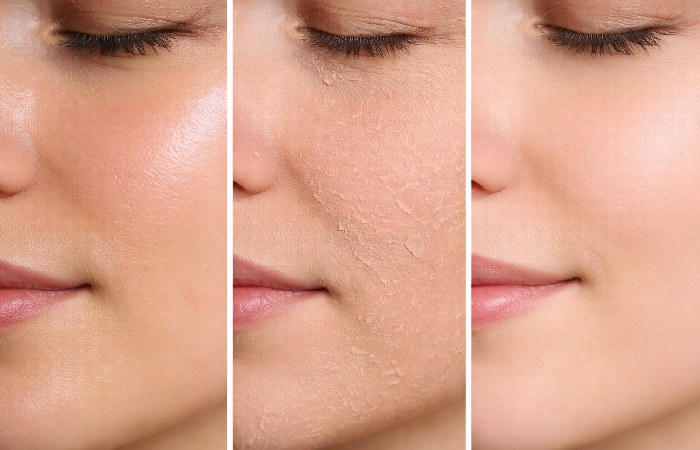
Before buying a single product, know what you’re working with. Using the wrong formulations for your skin type can make problems noticeably worse — a rich cream designed for dry skin will clog pores on an oily complexion.
The 5 Main Skin Types
| Skin Type | Key Characteristics | Common Concerns |
|---|---|---|
| Normal | Balanced oil production, minimal pores, even texture | Few blemishes, minimal sensitivity |
| Oily | Visible shine, enlarged pores, prone to breakouts | Acne, blackheads, excess sebum |
| Dry | Tight, flaky, or rough texture | Redness, irritation, fine lines |
| Combination | Oily T-zone (forehead, nose, chin), dry cheeks | Varied concerns across facial zones |
| Sensitive | Reacts easily to products or environment | Redness, stinging, rosacea flare-ups |
How to check yours: Wash your face with a gentle cleanser, pat dry, and wait 30 minutes without applying anything. If your skin feels tight, it leans dry. Shine all over points to oily. Shine only in the T-zone means combination. Comfortable with no extremes? You’re in the normal range. Skin that stings or reddens quickly is sensitive.
The Core Facial Care Routine: Step-by-Step
A complete facial care routine has two versions — morning and evening. They share some steps but serve different biological purposes. Morning is about protection; evening is about repair. This distinction matters more than most guides let on.
Your Morning Facial Care Routine
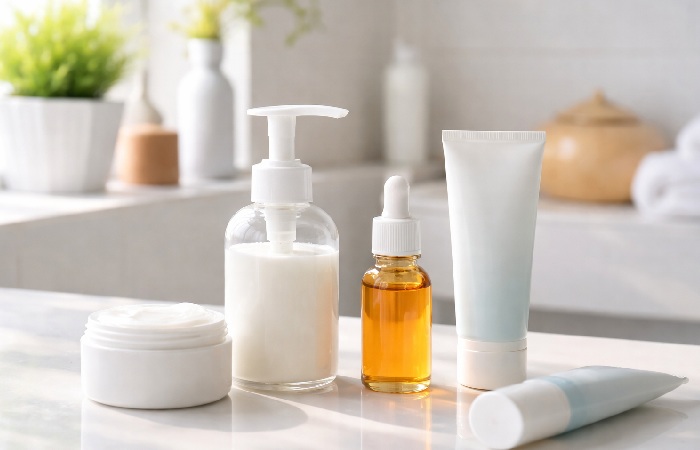
- Cleanser — Removes sweat, oils, and overnight product residue. Use a gentle, low-pH formula. For dry or sensitive skin, a splash of lukewarm water may be enough in the AM — aggressive morning cleansing can strip the barrier before it’s even had a chance to work.
- Toner (optional) — Rebalances the skin’s pH post-cleanse and preps for absorption. Hydrating toners with glycerin or hyaluronic acid work well for most skin types.
- Vitamin C Serum — The most evidence-supported antioxidant for daytime use. It neutralizes free radicals from UV and pollution, supports collagen synthesis, and gradually brightens uneven tone. Apply before moisturizer, on dry skin.
- Moisturizer — Seals in hydration and supports the skin barrier. Choose a lightweight gel for oily skin; a cream formula for dry or combination.
- SPF 30 or higher — Non-negotiable, full stop. Apply as the final step, over moisturizer. According to the Skin Cancer Foundation, regular use of broad-spectrum sunscreen can help significantly lower the risk of developing squamous cell carcinoma and melanoma over time. No serum cancels out skipping this step.
Your Evening Facial Care Routine
- Oil Cleanser or Micellar Water (first cleanse) — Breaks down sunscreen, makeup, and daytime sebum. Especially important if you wore SPF or any makeup product.
- Water-Based Cleanser (second cleanse) — Cleans the skin itself. This two-step approach — double cleansing — is widely recommended by dermatologists for thorough removal without stripping the skin dry.
- Exfoliant (2–3x per week, not daily) — Chemical exfoliants (AHAs like glycolic or lactic acid; BHAs like salicylic acid) outperform physical scrubs for most skin types — more effective, less abrasive. More on timing below.
- Treatment Serum — Evening is when your skin enters repair mode. This is the window for actives like retinol, niacinamide, or peptides. Apply to clean, dry skin before moisturizer.
- Moisturizer or Night Cream — Richer formulas are well-tolerated at night since you’re not layering SPF over them.
- Facial Oil (optional) — Applied last to seal moisture in. Most beneficial for dry or mature skin types.
Key Facial Care Ingredients: What Works, What to Skip, and What Never to Mix
The ingredient list on your products matters more than the brand name. Here’s what the evidence actually supports — and the combinations that quietly undermine even solid routines.
Active Ingredients: A Reference Matrix
| Ingredient | Primary Benefit | Best For | Use Time |
|---|---|---|---|
| Vitamin C (L-ascorbic acid) | Antioxidant protection, brightening, collagen support | All skin types, especially dull or uneven tone | Morning |
| Retinol / Retinal | Cell turnover acceleration, anti-aging, acne control | Normal, oily, aging skin | Evening only |
| Hyaluronic Acid | Deep hydration, plumping effect | All skin types, especially dry or dehydrated | Morning + Evening |
| Niacinamide | Pore minimizing, sebum regulation, barrier repair | Oily, combination, sensitive skin | Morning + Evening |
| AHA (Glycolic / Lactic Acid) | Exfoliation, improved texture and tone | Dry, dull, sun-damaged skin | Evening, 2–3x/week |
| BHA (Salicylic Acid) | Deep pore cleansing, acne control | Oily, acne-prone skin | Evening, 2–3x/week |
| Ceramides | Barrier repair, moisture retention | Dry, sensitive, compromised barrier | Morning + Evening |
| Ectoin | Microbiome protection, anti-inflammatory | Sensitive, reactive, environmentally stressed skin | Morning + Evening |
Retinal vs. Retinol — what’s the difference? Retinol must be converted twice by the skin before it becomes active retinoic acid. Retinal (retinaldehyde) requires only one conversion step, making it roughly 11 times more potent at equivalent concentrations — with studies suggesting a faster response timeline and comparable tolerability. If you’ve used retinol for over a year without sufficient results, retinal is a logical next step.
Ingredient Combinations to Avoid
Here’s where most routines silently break down. Certain actives cancel each other out — or worse, cause irritation when applied together.
- Retinol + Vitamin C (same session) — Both are potent actives optimized at different pH levels. Pairing them in the same application can reduce the efficacy of both and significantly increase irritation risk. The fix is simple: Vitamin C in the morning, retinol at night.
- AHAs/BHAs + Retinol (same session) — Exfoliating acids and retinoids together push the skin into over-exfoliation territory fast. Alternate nights instead of doubling up.
- Vitamin C + Niacinamide (high concentration, same session) — At elevated concentrations, these two may temporarily form niacin, causing flushing in reactive skin. Modern stabilized formulas have reduced this risk substantially, but spacing them AM/PM is still the safer approach if you’re sensitive.
- Multiple physical exfoliants in one session — A scrub layered on top of an AHA/BHA application is a barrier-compromise waiting to happen. One exfoliation method per session.
Facial Care by Skin Type: Personalized Routines
Oily Skin Facial Care
Oily skin overproduces sebum — often a response to dehydration or hormonal activity, not some inherent flaw. The goal isn’t to strip oil. It’s to rebalance. Harsh stripping cleansers trigger a rebound effect where sebaceous glands produce even more oil to compensate. That cycle is worth breaking early.
Key product choices:
- Cleanser: Gel or foaming formula with salicylic acid
- Moisturizer: Oil-free gel, labeled non-comedogenic (look for dimethicone or glycerin as base)
- Actives: Niacinamide (regulates sebum output), BHA (clears congested pores)
- Avoid: Heavy occlusive creams, facial oils, balm cleansers
Dry Skin Facial Care
Dry skin lacks both lipids and moisture content, which accelerates the appearance of fine lines and leaves skin feeling persistently tight or rough. The priority is hydration layering and barrier reinforcement — not more actives.
Key product choices:
- Cleanser: Cream or milk cleanser, free of sulfates (SLS/SLES)
- Moisturizer: Rich cream with ceramides, glycerin, or shea butter
- Actives: Hyaluronic acid (draws moisture in), lactic acid (the gentlest AHA), peptides
- Avoid: Alcohol-heavy toners, harsh physical scrubs, hot water during cleansing
Sensitive Skin Facial Care
Sensitivity usually points to a compromised skin barrier — the outer layer isn’t retaining moisture or blocking irritants efficiently. The priority here is repair, not treatment. Aggressive actives at this stage typically make things worse before they get better.
Key product choices:
- Cleanser: Fragrance-free, minimal ingredient list (5–8 ingredients is a reasonable ceiling)
- Moisturizer: Barrier-repair formula with ceramides and ectoin
- Actives: Niacinamide (anti-inflammatory, barrier-supporting), azelaic acid (gentle brightening without the irritation profile of AHAs)
- Avoid: Fragrance, essential oils, high-concentration acids, retinol until the barrier has recovered
Combination Skin Facial Care
Combination skin doesn’t always call for zone-specific products — but it does require some strategic thinking. Using a single heavy moisturizer uniformly across an oily T-zone and dry cheeks creates two separate problems at once.
Key product choices:
- Cleanser: Gentle gel cleanser (balanced, not targeting either extreme)
- Moisturizer: Lightweight lotion across the face; apply a richer cream only to dry zones
- Actives: Niacinamide (works across all zones), gentle BHA for T-zone congestion
- Avoid: One-size-fits-all heavy creams applied uniformly
The Skin Barrier: The Foundation Most People Unknowingly Damage
The skin barrier — technically the stratum corneum — is the outermost layer of the epidermis. It functions as both a wall (keeping bacteria, pollutants, and UV out) and a seal (keeping moisture in). Research published in the Journal of Clinical and Aesthetic Dermatology identifies barrier dysfunction as the underlying driver of eczema, acne flare-ups, rosacea, and chronic dryness — conditions that look different on the surface but share the same root cause.
But here’s the issue most guides miss: the three most common ways people damage their skin barrier are things they’re doing while trying to improve their skin — over-cleansing, over-exfoliating, and stacking too many actives at once.
Signs your barrier is compromised:
- Products you’ve used comfortably for months suddenly sting or irritate
- Persistent redness that doesn’t resolve between applications
- Skin that feels tight immediately after a gentle cleanse
- Breakouts appearing in zones where you rarely had them before
How to repair it: Strip back to basics. Use only a gentle cleanser, a ceramide-rich moisturizer, and SPF — for 2 to 4 weeks. Let the barrier rebuild before reintroducing actives one at a time.
Facial Care by Age: What Actually Changes Each Decade
Most guides treat skincare as age-agnostic. It isn’t.
In your 20s: Concentrate on prevention. SPF every morning, without exception. Add a vitamin C serum. A clean 4-step routine — cleanser, vitamin C, moisturizer, SPF — handles the vast majority of concerns at this stage.
In your 30s: Collagen production starts to slow measurably around age 25–30. This is the time to introduce retinol or retinal into the evening routine. Peptide serums become genuinely worthwhile here, not just a luxury add-on.
In your 40s and beyond: Prioritize hydration, barrier support, and consistent retinoid use. Sebaceous gland activity decreases with age, so skin naturally becomes drier. Rich moisturizers, ceramide-heavy formulas, and facial oils earn their place at this stage in ways they don’t in your 20s.
Common Facial Care Mistakes to Avoid
- Skipping SPF indoors — UVA rays penetrate glass. Sitting near a window means UV exposure is happening.
- Switching products too fast — Most actives need 4–12 weeks to show visible results. Changing every two weeks means nothing ever has time to work.
- Over-exfoliating — Two to three times per week is the evidence-backed ceiling for most skin types. More is barrier damage, not better results.
- Applying products in the wrong order — General rule: thinnest to thickest. Serums before moisturizer; moisturizer before SPF.
- Using hot water to cleanse — Hot water strips natural lipids and aggravates any form of sensitivity. Lukewarm is the standard.
- Stopping at the jawline — The neck and décolletage age at the same rate as the face. Extend SPF and retinol downward.
Budget vs. Full Routine: What You Actually Need
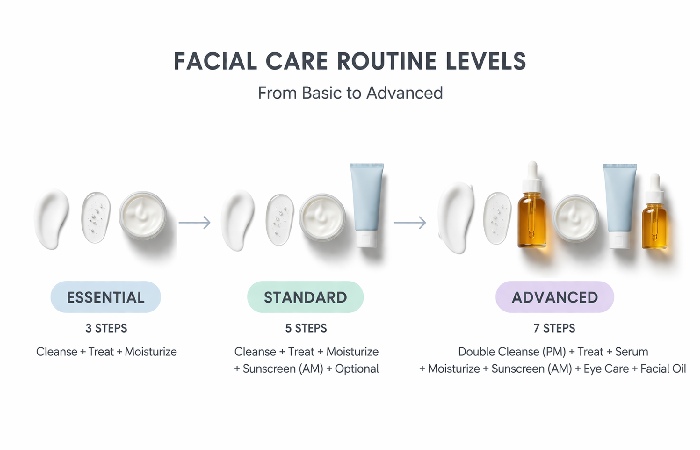
Not everyone needs a 7-step system. Here’s a realistic tier breakdown.
| Tier | Steps | Products | Best For |
|---|---|---|---|
| Essential (3 steps) | Cleanse → Moisturize → SPF | 3 products | Beginners, minimal budgets, travel |
| Standard (5 steps) | + Toner + Treatment Serum | 5 products | Most adults targeting 1–2 specific concerns |
| Advanced (7 steps) | + Exfoliant + Eye Cream or Facial Oil | 6–8 products | Experienced users, multiple concerns |
The Essential tier works. Consistent SPF alone puts you ahead of the majority of people using expensive 10-step routines sporadically. Start there, build only when each step feels like habit.
Who This Guide Is For — and Who Needs a Dermatologist
This routine guide is ideal for:
- Beginners building their first structured facial care routine
- Intermediate users adding actives safely
- Adults managing mild dryness, uneven tone, or early aging concerns
- Anyone with oily, dry, combination, or normal skin doing general maintenance
Book a dermatology appointment if you have:
- Active cystic acne — prescription retinoids and antibiotics are often clinically necessary
- Rosacea — many standard actives trigger flares and require medical management
- Eczema or psoriasis — barrier-based medical treatment is typically required
- Suspected contact dermatitis or allergic reactions to skincare
- Any unusual skin change or growth needing professional evaluation
Over-the-counter facial care routines are powerful tools for most people. They are not a substitute for clinical treatment when a medical condition is present.
Final Verdict: Build the Routine Your Skin Can Actually Sustain
Good facial care comes down to three principles: know your skin type, protect the barrier, and be consistent.
Start with the Essential tier — a gentle cleanser, a moisturizer suited to your skin type, and SPF 30 or higher every morning. Once those three steps feel automatic, add a vitamin C serum in the AM and a retinol in the PM. That five-step facial care routine, maintained without gaps, outperforms most elaborate systems used sporadically.
Save the ingredient combination warnings in this guide. The single most common reason solid routines fail isn’t the products — it’s layering actives that work against each other. Keep the logic clean: antioxidants and protection in the morning, repair and cell turnover at night.
Facial care isn’t about perfection. It’s about building a system your skin — and your schedule — can actually stick to.
Frequently Asked Questions
Q: What is the correct order to apply facial care products?
A: Apply products from thinnest to thickest consistency: cleanser → toner → serum → moisturizer → SPF (morning only). In the evening, replace SPF with a night cream or facial oil. Active treatments like retinol and exfoliants go after cleansing, before moisturizer.
Q: How do I figure out my skin type for facial care?
A: Cleanse your face, pat dry, and wait 30 minutes without applying anything. Shine all over = oily. Tightness or flaking = dry. Shine on forehead, nose, and chin only = combination. Comfortable with no extreme = normal. Stinging or reddening easily = sensitive.
Q: Can I use the same facial care products morning and night?
A: Some products — a gentle cleanser, hyaluronic acid serum, moisturizer — work for both. Vitamin C and SPF are morning-only; retinol and exfoliating acids are evening-only. Using them at the wrong time reduces efficacy and raises irritation risk.
Q: How long does a facial care routine take to show results?
A: Basic hydration improvements can appear within days. Meaningful changes to skin texture, tone, or acne typically take 4–12 weeks depending on the concern and actives used. Retinol requires 8–12 weeks to show its full anti-aging effect — most people quit too early.
Q: What is the most important step in a facial care routine?
A: SPF. UV exposure drives up to 80% of visible facial aging, according to clinical dermatology research. No amount of vitamin C, retinol, or peptides will undo the cumulative damage from skipping daily sun protection.
Q: Is facial care the same as skincare?
A: Facial care is a subset of skincare. Skincare covers the entire body; facial care refers specifically to the face — which demands more targeted treatment due to higher sebaceous gland density, greater sun exposure, and greater sensitivity compared to most other body skin.
About Marketingsguide
Marketingsguide.com publishes practical, easy-to-understand content on health, technology, business, marketing, and lifestyle. Articles are based mainly on reputable, publicly available information, with AI tools used only to help research, organise, and explain topics more clearly so the focus stays on real‑world usefulness rather than jargon or unnecessary complexity.
Disclaimer
This facial care guide is for general informational purposes only and is not a substitute for professional medical advice, diagnosis, or treatment. Always consult a dermatologist or qualified healthcare provider about your specific skin concerns before starting new products or routines.