Your heart beats roughly **100,000 times a day**. But most people have no idea whether that number reflects good health — or a quiet warning they’re ignoring. Heart rate is simply how many times your heart beats per minute (bpm).
A typical resting value for adults falls between **60 and 100 bpm**, but what counts as “healthy” also depends on age, fitness, and medical history.
This guide breaks down everything you need to know: normal ranges by age, how to check your pulse accurately, target zones for exercise, and the specific situations that require medical attention. Whether a wearable just flashed a number at you or your doctor mentioned your pulse, this is the reference you can come back to.
  • What is heart rate?

The number of beats per minute (bpm), showing how hard your heart is working at that moment.

  • What’s a normal resting value?

For most adults: **60–100 bpm** at rest. Many healthy people sit closer to **60–80 bpm**, and trained athletes can be as low as **40–60 bpm**.

  • What is a low / normal / high resting rate?

Category Resting Heart Rate (bpm)
Low Below 60
Normal 60–100
High Above 100
  • How do you check it?

Place two fingers on your wrist or neck, count beats for **15 seconds**, then multiply by **4** to get bpm.

  • What about during exercise?

Aim for **50–85%** of your estimated maximum (220 − your age) during cardio workouts.

  • When should you worry?

A resting value that stays **above 100 bpm** or **below 50 bpm** with symptoms like dizziness, chest pain, fainting, or shortness of breath should be checked by a doctor.

Types of Heart Rate Measurements

  • Resting heart rate (RHR)
  • Maximum heart rate (MHR)
  • Target heart rate (exercise zones)

What Is Heart Rate?

Heart rate is the number of times your heart contracts and pumps blood each minute, measured in **beats per minute (bpm)**. It reflects how hard your cardiovascular system is working to deliver oxygen and nutrients throughout your body.
Your heart rate isn’t fixed. It rises when you exercise, feel stressed, or drink caffeine. It drops when you sleep or relax. According to the American Heart Association, these fluctuations are completely normal and are managed by your body’s autonomic nervous system.

Heart Rate vs. Pulse — Is There a Difference?

The terms are often used interchangeably, but they’re not identical. **Heart rate** measures electrical contractions of the heart muscle. **Pulse** is the physical expansion of arteries you can feel at your wrist or neck as blood surges through.
In healthy people, heart rate and pulse match. But in some cardiac conditions — like certain arrhythmias — the heart may contract without producing a detectable pulse. For everyday monitoring, checking your pulse gives an accurate picture of your heart rate.

How Your Heart Rate Works (The Mechanism)

Your heart’s rhythm starts with a tiny cluster of cells called the **sinoatrial (SA) node**, located in the upper right chamber. This natural pacemaker generates electrical impulses that travel through the heart, triggering each contraction.
Two branches of your nervous system regulate speed:
  • Sympathetic nervous system** — Speeds up heart rate during stress, exercise, or danger (the fight-or-flight response).
  • Parasympathetic nervous system** — Slows heart rate during rest and recovery, primarily through the vagus nerve.
This balance between acceleration and braking determines your heart rate at any given moment.

What Is a Normal Resting Heart Rate?

Your **resting heart rate** is your pulse when you’re awake, calm, and haven’t been physically active for at least 5–10 minutes.
For most adults, the usual range is **60 to 100 bpm**. Lower values within that band are generally linked with better cardiovascular fitness and lower long‑term risk, as long as you feel well and have no concerning symptoms.

Quick Resting Heart Rate Reference

Category Resting Heart Rate (bpm)
Low Below 60
Normal 60–100
High Above 100

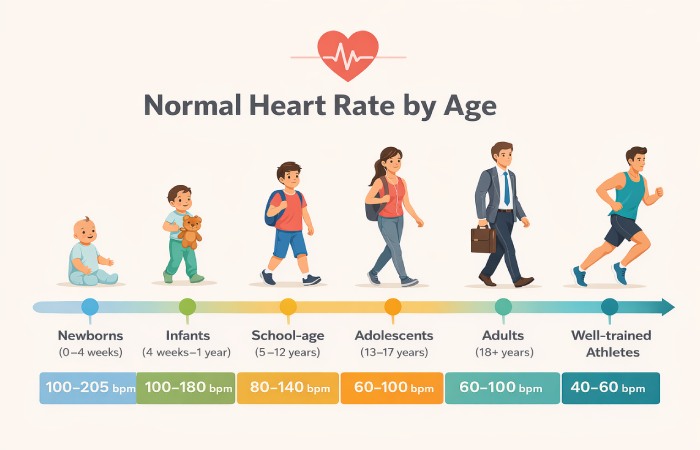
Normal Heart Rate by Age Chart

Normal resting heart rate ranges by age chart
Typical resting heart rate ranges vary by age, with children having faster pulses than adults.
Heart rate ranges shift across the lifespan. Children naturally have faster pulses because their hearts are smaller and need to beat more often to circulate blood.
Age Group Normal Resting Heart Rate (bpm)
Newborns (0–4 weeks) 100–205
Infants (4 weeks–1 year) 100–180
Toddlers (1–3 years) 80–140
Preschool (3–5 years) 80–120
School-age (5–12 years) 75–118
Adolescents (13–17 years) 60–100
Adults (18+ years) 60–100
Well-trained athletes 40–60
*Source: Cleveland Clinic, American Heart Association*
During **sleep**, your pulse naturally dips. Readings in the **40–50 bpm** range overnight can be normal for many adults and aren’t usually a concern if you feel well during the day.

Why “Normal” Doesn’t Always Mean “Healthy”

This is where many guides oversimplify things. A resting value of **95 bpm** is technically within the 60–100 bpm “normal” range — but it doesn’t carry the same risk profile as **62 bpm.
Studies in major cardiology journals have found that resting rates consistently above about **80 bpm** are associated with higher chances of cardiovascular events, even in people without diagnosed heart disease. For many adults, a value in roughly the **60–70 bpm** range is considered a healthy target.
One reading on its own means very little. **Trends over time** are far more informative than a single number. If your wearable shows your typical resting rate creeping up over weeks, that’s a good reason to talk with a healthcare provider — even if each individual reading technically sits inside the “normal” band.

How to Check Your Heart Rate

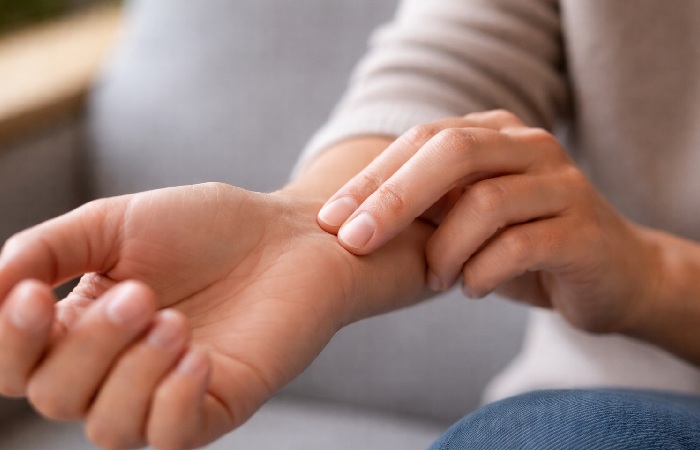
Fingers checking radial pulse on wrist
Checking the radial pulse at the wrist is one of the easiest ways to measure heart rate.
You don’t need expensive equipment. Two fingers and a clock are enough.

Manual Pulse Check (Wrist and Neck)

At the wrist (radial pulse):
  1. Turn your palm face‑up.
  2. Place your index and middle fingers on the inside of your opposite wrist, just below the base of your thumb.
  3. Press lightly until you feel a steady pulse.
  4. Count the beats for **15 seconds**, then multiply by **4**.
At the neck (carotid pulse):
  1. Place your index and middle fingers on the side of your neck, just beside your windpipe.
  2. Press gently — too much pressure can temporarily slow the pulse.
  3. Count for **15 seconds** and multiply by **4**.
Tip:** For the most accurate resting measurement, check it first thing in the morning — before getting out of bed, drinking coffee, or checking your phone.

Heart Rate Monitors and Wearable Devices
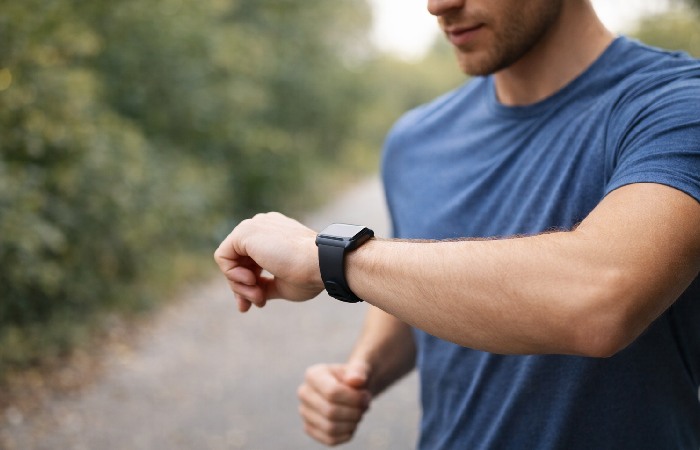
Runner wearing smartwatch tracking heart rate
Fitness trackers and smartwatches help monitor heart rate trends during daily activity and exercise.
Wrist-based wearables (Apple Watch, Fitbit, Garmin) use **optical sensors** that shine light through the skin and detect blood flow changes. They’re convenient for tracking trends over days and weeks.
Chest-strap monitors (like the Polar H10) use **electrical sensors** similar to an ECG and tend to be more accurate, especially during high-intensity exercise.
One thing to keep in mind: **optical wrist sensors can be unreliable** during vigorous movement, if the band is loose, or on darker skin tones. If you’re making health decisions based on heart rate data, a chest strap during exercise and a morning manual check at rest will give you the most reliable numbers.

Factors That Affect Your Heart Rate

Heart rate isn’t just about your heart. Your entire body influences it:
  • Fitness level** — Regular aerobic exercise strengthens the heart, allowing it to pump more blood per beat, which often lowers resting values over time.
  • Stress and emotions** — Anxiety, anger, excitement, and grief can all spike your pulse through sympathetic nervous system activation.
  • Medications** — Beta‑blockers slow it down, while decongestants, stimulants, and some asthma drugs can make it faster.
  • Caffeine and nicotine** — Both are stimulants that temporarily increase the rate.
  • Dehydration** — Less fluid in the bloodstream forces the heart to beat faster to maintain blood pressure.
  • Body temperature** — Fever, hot weather, or a hot bath can elevate readings by 5–10 bpm.
  • Body position** — Values may briefly rise when you stand after sitting or lying down (orthostatic response).
  • Sleep quality** — Poor or fragmented sleep often raises your resting number the following day.
  • Pregnancy** — Blood volume can increase by up to 50%, raising resting levels by 10–20 bpm.
  • Chronic conditions** — Thyroid disorders, anemia, infections, and cardiovascular disease all play a role.

Understanding these factors helps you interpret a reading in context instead of reacting to a single number in isolation.

Target Heart Rate Zones for Exercise

Person performing cardio exercise workout
Monitoring heart rate during exercise helps ensure workouts stay within safe and effective intensity zones.
Your pulse during a workout tells you whether you’re working hard enough — or pushing too hard. Training within specific zones helps you build endurance, burn fat, and improve cardiovascular fitness safely.
The National Institutes of Health recommends exercising within **50% to 85%** of your maximum heart rate for effective cardiovascular benefits.

How to Calculate Your Maximum Heart Rate

The most widely used formula is simple:
Maximum Heart Rate (MHR) = 220 − your age
For example, a 40‑year‑old has an estimated MHR of **180 bpm**. This is a rough estimate — individual variation exists — but it’s a practical starting point.

Heart Rate Zones Explained

Zone % of Max HR Intensity What It Feels Like Primary Benefit
Zone 1 50–60% Very light Easy conversation, minimal effort Warm-up, active recovery
Zone 2 60–70% Light Comfortable, can talk freely Fat burning, base endurance
Zone 3 70–80% Moderate Breathing harder, short sentences Aerobic fitness, stamina
Zone 4 80–90% Hard Difficult to talk, sustained push Speed, lactate threshold
Zone 5 90–100% Maximum All-out effort, cannot speak Peak power, sprint capacity
**Practical example:** A 30‑year‑old with an estimated MHR of 190 bpm would target:
  • Zone 2 (endurance run): **114–133 bpm**
  • Zone 4 (interval training): **152–171 bpm**

When starting a new exercise routine, aim for **Zone 2** and gradually increase intensity over weeks. Jumping straight into the higher zones without a fitness base increases injury and overtraining risk.

Heart Rate Variability (HRV)

Heart Rate Variability (HRV) refers to the small differences in time between individual heartbeats. Even at the same heart rate, the exact gap between beats is not perfectly even.

In general, higher HRV is linked with better cardiovascular fitness, stronger stress resilience, and a healthier balance in your nervous system. Lower HRV may appear during illness, fatigue, poor sleep, or chronic stress.

Heart Rate Recovery — The Fitness Metric Most People Ignore

Most heart rate guides focus on what happens during exercise. But what happens **after** may matter more.
**Heart rate recovery (HRR)** measures how quickly your heart rate drops after you stop exercising. It reflects how efficiently your parasympathetic nervous system — specifically the vagus nerve — can “slam the brakes” and bring your body back to rest.

What Is a Good Recovery Heart Rate?

After stopping moderate-to-vigorous exercise:
  • Healthy recovery:** Heart rate drops by **12 bpm or more** within the first minute.
  • Excellent recovery:** Heart rate drops by **20+ bpm** in the first minute.
  • Concerning recovery:** Heart rate drops by **fewer than 12 bpm** after one minute.

Why HRR Predicts Longevity Better Than Resting HR

Research published in the *New England Journal of Medicine* found that people whose heart rate dropped by fewer than 12 bpm in the first minute after exercise had significantly higher mortality risk over the following six years — regardless of whether they had other cardiac risk factors.
HRR is a window into your autonomic nervous system health. Slow recovery suggests reduced vagal tone, which is associated with higher inflammation, worse stress resilience, and greater cardiovascular risk.
The good news: HRR improves with consistent aerobic exercise. If your recovery is slow now, regular Zone 2 training over 8–12 weeks can produce measurable improvement.

When Is Your Heart Rate Dangerous?

Not every unusual reading requires a trip to the emergency room. But some patterns and symptoms do.

Tachycardia — When Your Heart Beats Too Fast

Tachycardia** is a resting heart rate **above 100 bpm**. It’s normal during exercise, fever, or acute stress. It’s concerning when it happens at rest without an obvious trigger.
Causes include dehydration, excess caffeine intake, anxiety disorders, hyperthyroidism, anemia, and cardiac conditions like atrial fibrillation or supraventricular tachycardia (SVT).
Seek immediate care if a fast heart rate accompanies:
  • Chest pain or tightness
  • Severe shortness of breath
  • Fainting or near-fainting
  • Sudden confusion

Bradycardia — When Your Heart Beats Too Slow

Bradycardia  is a resting heart rate **below 60 bpm**. In well-trained athletes, this is often a sign of exceptional cardiovascular fitness. In sedentary individuals or elderly patients, it can signal a problem.
Causes include certain medications (beta-blockers, calcium channel blockers), underactive thyroid, and heart block — a condition where electrical signals in the heart are delayed or disrupted.
A low heart rate is concerning if you experience **dizziness, fatigue, fainting, or difficulty exercising** despite feeling motivated. Don’t assume that a low reading always means you’re fit.

Heart Palpitations vs. Arrhythmia

Palpitations are the sensation that your heart is racing, fluttering, or skipping a beat. They’re extremely common and are usually caused by caffeine, stress, or lack of sleep.

Arrhythmia** is a clinically diagnosed irregular heart rhythm — where the electrical signals that coordinate heartbeats misfire. Some arrhythmias are harmless (like occasional premature beats). Others, like atrial fibrillation, increase stroke risk and require treatment. Mayo Clinic advises seeking immediate medical attention if palpitations are frequent, worsening, or accompanied by chest pain, fainting, or severe dizziness.
Quick Decision Checklist — When to Call Your Doctor:
  • Resting heart rate consistently above 100 bpm without exercise or stress
  • Resting heart rate consistently below 50 bpm with symptoms (dizziness, fatigue)
  • Irregular heartbeat that happens frequently
  • Palpitations combined with chest pain, shortness of breath, or fainting
  • Heart rate doesn’t drop within a few minutes of stopping exercise
  • Sudden unexplained change in resting heart rate trend over days or weeks

Common Heart Rate Mistakes and Misconceptions

  • Anything under 100 bpm is fine.”** Not exactly. A consistent resting rate of 90–100 bpm — while technically normal — is associated with elevated cardiovascular risk. Lower is generally healthier.
  • My watch says my heart rate is high, so something is wrong.”** Wrist-based optical sensors can misread during movement. Verify with a manual pulse check before worrying.
  • A low heart rate means I’m super fit.”** Sometimes. But bradycardia can also indicate heart block or medication side effects. Fitness-related bradycardia is usually asymptomatic.
  • I should stay in the ‘fat-burning zone’ to lose weight.”** Zone 2 burns a higher *percentage* of fat, but higher zones burn more *total calories* per minute. The best zone for weight loss is the one you sustain consistently.
  • Checking my heart rate once tells me everything.”** A single reading is a snapshot. Tracking trends over weeks gives far more useful information.

Who Should Monitor Heart Rate Closely — and Who Doesn’t Need To

**Routine monitoring is most valuable for:**
  • People with diagnosed cardiovascular conditions
  • Anyone taking medications that affect heart rate (beta-blockers, anti-arrhythmics)
  • Endurance athletes optimizing training load
  • Pregnant women tracking physiological changes
  • Individuals recovering from cardiac events
**Monitoring is less necessary for:**
  • Healthy adults with no symptoms and no cardiac history
  • People prone to **health anxiety** — constant checking can increase stress and paradoxically raise heart rate
  • Those without a structured plan for interpreting or acting on the data
If checking your heart rate makes you more anxious rather than more informed, step back. Talk to your doctor about establishing a baseline, then check periodically rather than obsessively.

Why Monitoring Heart Rate Matters

Monitoring your heart rate over time helps you understand your cardiovascular health, track fitness progress, and adjust exercise intensity. It’s not a tool for self‑diagnosing heart disease, but it can highlight patterns or changes that are worth discussing with your doctor.

Final Verdict — Understanding Your Heart Rate

Your pulse is one of the simplest and most accessible vital signs you have. It costs nothing to check, takes seconds, and gives you real insight into cardiovascular health, fitness progress, and stress levels.
For most adults, a resting value between **60 and 80 bpm** is a healthy target, but the ideal number still depends on your body, fitness, and medical history.  Trends matter more than individual readings. Recovery after exercise is an underused but powerful predictor of long‑term heart health, and any abnormal number that comes with symptoms is a reason to seek medical evaluation — not something to ignore.
Check your baseline. Track it occasionally. Know your zones. And don’t ignore what your heart — and your body — are telling you.

Frequently Asked Questions

Q: What is a normal heart rate for adults?

A: A normal resting heart rate for adults ranges from 60 to 100 beats per minute (bpm). However, a rate between 60 and 80 bpm is generally considered healthier. Well-trained athletes may have resting rates as low as 40–60 bpm due to greater cardiac efficiency.

Q: What heart rate is dangerously high?

A: A resting heart rate consistently above 100 bpm is classified as tachycardia and should be evaluated. Seek emergency care if a fast heart rate comes with chest pain, shortness of breath, fainting, or confusion.

Q: How do I check my heart rate without a device?

A: Place your index and middle fingers on the inside of your wrist, just below the thumb. Press gently until you feel your pulse. Count beats for 15 seconds and multiply by 4 to get your beats per minute.

Q: What is a good normal resting heart rate by age?

A: For adults 18 and older, 60–100 bpm is normal. Children have higher ranges — newborns can reach 100–205 bpm. Among adults, a resting rate in the 60–70 bpm range tends to indicate strong cardiovascular health.

Q: Does anxiety affect it?

A: Yes. Anxiety activates the sympathetic nervous system (fight-or-flight response), which can spike heart rate above 100 bpm — sometimes even above 150 bpm during a panic attack. This is usually temporary and not dangerous, but persistent tachycardia from anxiety should be discussed with a doctor.

Q: What is normal heart rate recovery and why does it matter?

A: Heart rate recovery (HRR) measures how quickly your heart rate drops after stopping exercise. A healthy drop is 12+ bpm within the first minute. Research links slow recovery to higher cardiovascular mortality risk, making HRR one of the most meaningful fitness metrics available.

About Marketingsguide

Marketingsguide publishes practical, easy-to-understand content on health, technology, business, marketing, and lifestyle. Articles are based mainly on reputable, publicly available information, with AI tools used only to help research, organise, and explain topics more clearly so the focus stays on real‑world usefulness rather than jargon or unnecessary complexity.

Disclaimer

This content is for general information only and is not a substitute for professional medical advice, diagnosis, or treatment. Always consult a qualified healthcare provider about your own health, and seek emergency care right away if you have severe symptoms like chest pain, trouble breathing, or fainting.