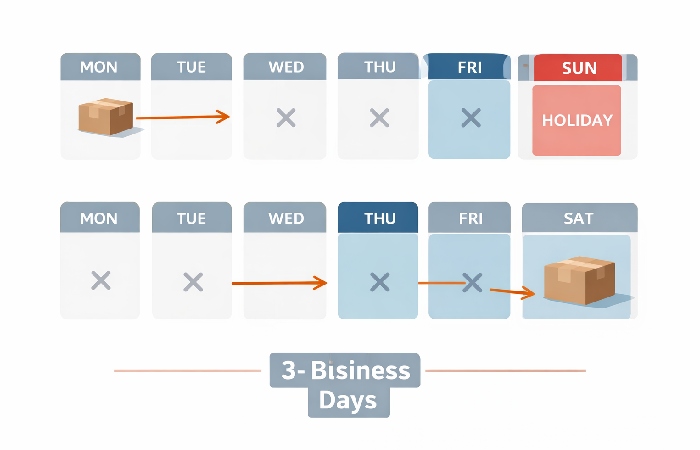
You see “3–5 business days” on a shipping confirmation, and suddenly you’re doing mental math. **Is Saturday included? Does the day you ordered count? What about that holiday next Monday?**
If you’ve ever missed a deadline or waited longer than expected for a package because you miscounted business days, you’re not alone. The concept sounds simple, but the details trip people up constantly.
A **business day** is typically an **8-hour period — 9:00 AM to 5:00 PM — on any weekday from Monday through Friday**, excluding public holidays. That’s the short answer. But how it applies to your situation depends on whether you’re tracking a shipment, waiting on a bank transfer, or reading a contract clause.
This guide covers exactly what counts as a business day, how to count them correctly, and how the rules change across shipping, banking, and international contexts.

Summary: How Long Is a Business Day?

  • How long?** → A business day is 8 hours (typically 9 AM–5 PM), Monday through Friday.
  • What’s excluded?** → Saturdays, Sundays, and public/federal holidays.
  • Business day vs calendar day?** → Calendar days count every day; business days skip weekends and holidays.
  • For shipping?** → Carriers count Mon–Fri only; the ship date usually doesn’t count as day one.
  • For banking?** → Banks process transactions only on business days; Friday transfers often clear Monday.

What Is a Business Day?

A **business day** is any day when standard commercial operations take place. In most countries — including the United States, Canada, the United Kingdom, and Australia — this means **Monday through Friday, excluding nationally recognized public holidays**.
A business day does not necessarily mean the business is physically open. It refers to the days when the broader commercial and financial infrastructure operates: banks process transactions, courts accept filings, and shipping carriers move packages.

The Standard Definition

A business day spans one full working day within the Monday-to-Friday workweek. While the term implies a 24-hour calendar period, the **operational window** most people reference is the 8-hour block from **9:00 AM to 5:00 PM local time**.
According to the U.S. Office of Personnel Management’s federal holiday schedule,there are **10 federal holidays** per year in the United States. These days are excluded from business day calculations for government agencies, banks, and most businesses.

Which Days Are Excluded?

  • Saturdays and Sundays** — always excluded in standard business day counts
  • Federal / public holidays** — New Year’s Day, Memorial Day, Independence Day, Labor Day, Thanksgiving, Christmas, and others
  • Company-specific closures** — some businesses add extra days (e.g., the day after Thanksgiving), but these are not universally excluded
Key point: If a deadline or delivery estimate uses the term “business days,” weekends and public holidays do **not** count toward the total.

How Many Hours Are in a Business Day?

The 8-Hour Standard

In most office-based jobs, a business day is treated as an 8‑hour work period (usually 9 AM–5 PM). This aligns with the traditional **9:00 AM to 5:00 PM** schedule that serves as the baseline for most office-based industries in the United States and Western Europe.
This 8-hour figure is rooted in labor standards. The **Fair Labor Standards Act (FLSA)** defines a standard workweek as 40 hours across five days, which breaks down to 8 hours per day. While the FLSA doesn’t explicitly define a “business day,” the 8-hour / 5-day framework is the practical norm that businesses, banks, and government agencies follow.

When Business Days Are Longer (or Shorter)

office employees working during a weekday business day
A business day usually refers to standard weekday working hours when commercial activity occurs.
Not every industry sticks to the 9-to-5 model. Here’s where it varies:
  • Retail and hospitality:** Operating hours often run 10+ hours (e.g., 10 AM–8 PM), but these extended hours don’t change the standard “business day” definition for shipping or financial purposes.
  • Government agencies:** Some federal offices operate **7:00 AM–3:30 PM**, a shorter daily window but still one business day.
  • Healthcare and emergency services:** These operate 24/7, but contractual and financial “business day” calculations still default to the Mon–Fri, 8-hour definition.
  • Japan:** A typical corporate business day runs **8:30 AM–7:00 PM**, significantly longer than Western norms.
The takeaway: your employer’s hours may differ, but when a bank, court, or shipping carrier says “business day,” they almost always mean the standard 8-hour weekday.

Business Day vs Calendar Day — What’s the Difference?

This is where most confusion happens. A calendar day and a business day are **not interchangeable**.
Feature Business Day Calendar Day
Days included Monday–Friday only Every day (Mon–Sun)
Holidays excluded? Yes No
Hours implied 8 hours (9 AM–5 PM) 24 hours (midnight–midnight)
Used by Banks, courts, carriers, contracts General deadlines, countdowns
5-day example (starting Monday) Due Friday Due Friday
5-day example (starting Wednesday) Due the following Wednesday Due Monday

How to Tell Which One Applies

  • Shipping estimates** almost always mean business days unless stated otherwise.
  • Legal deadlines** vary — always check whether the statute specifies “business” or “calendar” days.
  • Bank processing times** are always in business days.
  • Subscription trials** (e.g., “30-day free trial”) typically use calendar days.
When in doubt, assume **business days** for anything involving a financial institution, government body, or shipping carrier.

How to Count Business Days Correctly

calendar visual showing how business days are counted
Counting business days means skipping weekends and public holidays when calculating timelines.

Step-by-Step Counting Method

  1. Identify the start date.** This is usually the day *after* the action occurs. If you ship an order on Wednesday, day one is Thursday.
  2. Skip weekends.** Saturdays and Sundays do not count.
  3. Skip public holidays.** Check the Federal Reserve’s published holiday calendar for banking, or your national holiday list for other purposes.
  4. Count forward.** Each qualifying weekday adds one business day.
**Example:** An order ships on **Friday afternoon**. Delivery is estimated in **3 business days**.
  • Friday (ship date) → does **not** count
  • Saturday → skip
  • Sunday → skip
  • Monday → **Day 1
  • Tuesday → **Day 2
  • Wednesday → **Day 3
  • Expected delivery

Common Counting Mistakes

  • Counting the start day as day one.** Most systems start the count on the *next* business day.
  • Forgetting holidays.** A Monday holiday pushes everything forward by one day.
  • Assuming Saturday counts.** For most purposes, it does not — even if a business is open on Saturday.
  • Ignoring cut-off times.** An order placed at 7 PM on Monday may not enter the system until Tuesday morning.

Business Days for Shipping and Delivery

delivery worker handling parcels for weekday shipping
Shipping carriers calculate delivery estimates using weekday business days.

What Carriers Mean by “Business Day”

When USPS, UPS, or FedEx quotes delivery in “business days,” they mean **Monday through Friday, excluding federal holidays**. The specific delivery window varies:
Carrier Business Day Delivery Window Saturday Delivery?
USPS Mon–Sat, 9 AM–5 PM Yes (standard for most services)
UPS Mon–Fri, 9 AM–7 PM Select services only
FedEx Mon–Fri, 8 AM–8 PM Select services only
Note:** Even though USPS delivers on Saturdays, Saturday is typically **not** counted as a “business day” when calculating transit time estimates. Your “3 business days” estimate still counts Mon–Fri only.

Cut-Off Times and Why They Matter

Carriers set daily cut-off times — usually mid-to-late afternoon — after which a package won’t ship until the next business day. If your seller drops a package at UPS at **6:00 PM**, the first business day of transit starts the **following morning**.
This is the single biggest reason packages seem “late.” The business day count hasn’t started when you think it has.

Business Days in Banking and Finance

person using online banking during a business day
Banks process transfers, payments, and settlements only on official business days.

Transaction Processing Windows

Banks process transactions — including wire transfers, ACH payments, direct deposits, and check clearances — **only on business days**. Most domestic transactions are batched and processed overnight, meaning:
  • A transfer initiated on **Monday morning** typically clears by **Tuesday**.
  • A transfer initiated on **Friday afternoon** won’t process until **Monday night** and may not appear until **Tuesday**.
This is why the Federal Reserve calendar matters. If Monday is a federal holiday, that Friday transfer might not clear until **Wednesday**.

Federal Reserve Holidays

The Federal Reserve’s published holiday calendar lists the days when the Fed’s payment systems are closed. Banks cannot settle transactions on these days. The 2025–2026 schedule includes standard holidays plus any observed dates when a holiday falls on a weekend.
**Practical tip:** If you need a payment to clear by a specific date, initiate it **at least two business days early** to account for processing lag and potential holiday conflicts.

Business Days Around the World

Regional Workweek Variations

The Monday-through-Friday standard is not universal. If you work with international clients or vendors, these differences matter:
Region Standard Workweek Notes
United States, Canada, UK, EU Mon–Fri 10 federal holidays (US)
Middle East (UAE, Saudi Arabia) Mon–Fri (recently changed from Sun–Thu) UAE shifted to Mon–Fri in 2022
Israel Sun–Thu Friday and Saturday are the weekend
India Mon–Fri (corporate) or Mon–Sat (some sectors) Saturday is a half-day in many industries
Japan Mon–Fri Longer daily hours (8:30 AM–7 PM common)
Key consideration:** When a contract states “5 business days,” the applicable business days depend on the **jurisdiction specified in the contract**, not your local calendar.

Common Mistakes to Avoid

  • Assuming “business day” and “day” are the same thing.** They’re not. Five business days ≠ five calendar days.
  • Counting weekends when estimating delivery.** If your order ships Friday, don’t expect it by Sunday — the count hasn’t started yet.
  • Forgetting that holidays vary by country.** Coordinating with overseas suppliers? Their holidays are different from yours.
  • Ignoring cut-off times.** A 9 PM order on a Tuesday might not count as Tuesday for processing purposes.

Not checking the specific definition in contracts.** Some agreements define “business day” differently than the standard — always read the fine print.

Who Needs to Understand Business Days (and Who Can Ignore Them)

**This matters most for:**
  • Online shoppers** tracking shipping timelines
  • Freelancers and contractors** managing invoice payment terms (e.g., “Net 30 business days”)
  • HR and payroll professionals** processing pay cycles
  • Legal professionals** filing court documents with business-day deadlines
  • E-commerce sellers** setting accurate delivery expectations
**Less relevant for:**
  • Personal scheduling** — use calendar days for personal deadlines, event planning, and countdowns
  • 24/7 service industries** — the concept applies to their financial and legal operations, not their operating hours

Final Verdict

A business day is typically 8 hours — 9 AM to 5 PM — and falls on any weekday from Monday through Friday, excluding public holidays.
But the practical answer depends on context. For shipping, the count starts the day *after* dispatch and skips weekends. For banking, transactions only process on days the Federal Reserve is open. For international dealings, the workweek itself may be different.
**The most actionable advice:** when someone tells you “3–5 business days,” add a buffer. Account for weekends, holidays, and cut-off times. It’s better to be pleasantly surprised than frustrated by a “late” delivery that was actually right on schedule.

Frequently Asked Questions

Q: Is a business day 24 hours?

A: On the calendar, a business day covers one full weekday, but for most people it effectively means the 8‑hour working window (around 9 AM–5 PM). Most deadlines and processing windows reference this 8-hour period.

Q: Does Saturday count as a business day?

A: No. In most countries, Saturday is not a business day. Some services like USPS deliver on Saturdays, but Saturday is still excluded from standard business day calculations for shipping estimates and banking.

Q: What are standard business hours?

A: Standard business hours are **9:00 AM to 5:00 PM**, Monday through Friday, in most Western countries. Government agencies, banks, and corporate offices generally follow this schedule, though individual companies may vary.

Q: How many business days are in a week?

A: There are **5 business days** in a standard week: Monday, Tuesday, Wednesday, Thursday, and Friday. If a public holiday falls on one of these days, that week has only 4 business days.

Q: What is the difference between a business day and a working day?

A: In most contexts, “business day” and “working day” mean the same thing — a weekday when commercial operations occur. However, some countries or contracts may define them differently, so always check the specific language used.

Q: Does “1 business day” mean today?

A: Usually not. “1 business day” typically refers to the **next full business day** after the action. If you submit a request on Monday, the 1-business-day deadline is Tuesday. If you submit on Friday, it’s Monday (assuming no holiday).

About Marketingsguide

Marketingsguide publishes practical, easy-to-understand content on health, technology, business, marketing, and lifestyle. Articles are based mainly on reputable, publicly available information, with AI tools used only to help research, organise, and explain topics more clearly so the focus stays on real‑world usefulness rather than jargon or unnecessary complexity.

Disclaimer

This article is for general information only and is not legal, financial, or professional advice. Business day rules can vary by bank, carrier, employer, and jurisdiction. Always check the specific terms in your own agreements or consult a qualified professional for decisions about payments, deadlines, or legal obligations.