

You’re in the health food aisle — or scrolling an online cart — with a canister of shake powder in one hand and a box of meal replacement bars in the other. Both promise balanced nutrition, convenience, and weight management support. But they are not the same product.
Choosing the wrong format doesn’t just waste money. It can leave you hungry an hour later, or worst of all, buying a glorified candy bar dressed up as a “meal replacement.”
This guide breaks down the real differences between meal replacement shakes vs bars — backed by nutritional science — so you can make the right call for your lifestyle, goals, and budget.
Table of Contents
Quick Summary
- What’s the difference? → Shakes are liquid (faster absorption, lower satiety); bars are solid (slower digestion, better fullness)
- Which is better for weight loss? → Shakes allow more precise calorie control; bars provide better hunger suppression
- Which is more convenient? → Bars win for portability; shakes win for customization and hydration
- Bottom line → Neither is universally better. The right choice depends on when and how you’re using it.
What Is a Meal Replacement? (The Standard Most Products Miss)
A meal replacement is a nutritionally complete product designed to substitute a full meal. In practice, this means a product is formulated to deliver a balanced ratio of macronutrients — protein, carbohydrates, and fats — along with essential vitamins and minerals.
According to guidance used in the European Union, meal replacements for weight control are typically designed to provide around 200–400 calories per serving and to supply roughly 30% of the daily reference intakes for key vitamins and minerals, as outlined in this meal replacement guidance document. The U.S. FDA’s nutrition labeling standards focus on clear disclosure of calories and % Daily Value on the Nutrition Facts label so consumers can assess this completeness.
This standard matters — because most “protein bars” on the market do not meet it.
What Sets a True Meal Replacement Apart from a Protein Bar or Snack Bar
| Feature | True Meal Replacement | Protein Bar | Snack Bar |
|---|---|---|---|
| Calorie range | 200–400 kcal | 150–350 kcal | 100–250 kcal |
| Vitamins & minerals | ≥30% daily value | Usually <15% | Minimal |
| Macronutrient balance | Protein + Carbs + Fat | High protein focus | Carb-heavy |
| Intended purpose | Replace a full meal | Supplement protein | Snack/energy |
The takeaway: Before comparing shakes vs bars, confirm the product you’re buying is actually a meal replacement — not just rebranded protein.
Meal Replacement Shakes — What They Are and How They Work
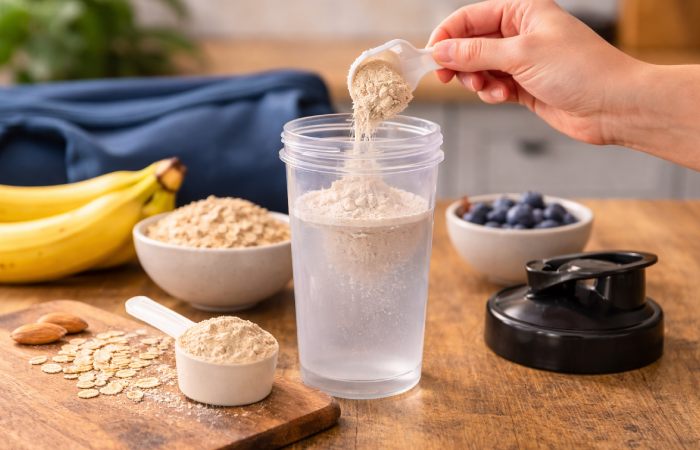
Meal replacement shakes are liquid nutritional formulas — available as ready-to-drink bottles or mixable powders — designed to provide a complete meal in beverage form. Once consumed, liquid meals begin entering the digestive system almost immediately. This means faster nutrient delivery but also a shorter window of satiety compared to solid food.
Benefits of Meal Replacement Shakes
- Fast nutrient absorption. Liquid digestion begins within minutes of consumption, making shakes ideal for post-workout recovery or when you need energy quickly.
- Precise calorie control. Powders can be mixed with different liquids (water, skim milk, oat milk) to fine-tune calorie and macronutrient intake with accuracy.
- Hydration bonus. Every shake contributes to daily fluid intake — an advantage bars cannot offer.
- Customizable. Add frozen berries, spinach, or nut butter to powdered shakes to boost micronutrient diversity.
- Useful for special medical needs. Shakes are often recommended for individuals who have difficulty chewing, are post-surgery, or need easily digestible nutrition.
Drawbacks of Meal Replacement Shakes (Including the Satiety Problem)
The biggest complaint about meal replacement shakes is consistent: they don’t keep you full.
Research in peer‑reviewed nutrition journals has found that solid meals often produce greater satiety than liquid meals of similar calorie content, even when calories are matched (example study). This appears to be partly because chewing and slower gastric emptying are associated with stronger fullness signals, involving hormones such as cholecystokinin (CCK).
In plain terms: chewing tells your brain you’ve eaten. Drinking does not trigger that same signal as effectively.
Other drawbacks:
- Some shakes are high in added sugars or artificial sweeteners, which can cause bloating or GI discomfort
- Ready-to-drink options can be expensive ($3–$5 per bottle)
- Powders require a blender or shaker bottle — less convenient than unwrapping a bar
- Long-term monotony: drinking the same shake daily leads to flavor fatigue
Meal Replacement Bars — What They Are and How They Work
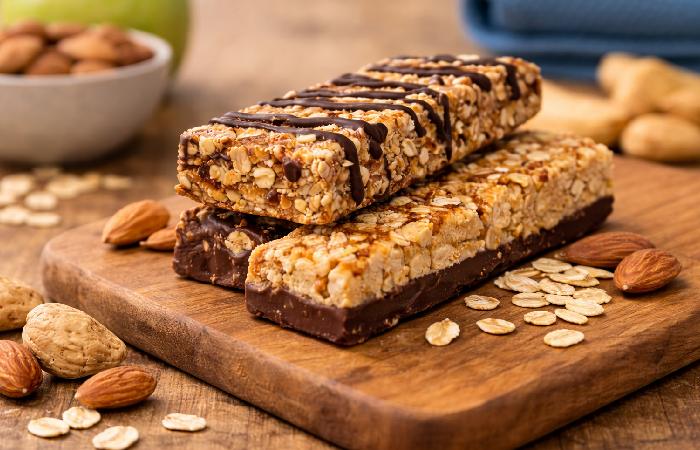
Meal replacement bars are solid, pre-portioned nutrition products formulated to deliver balanced macronutrients and micronutrients in bar form. They are the most portable meal replacement format — no mixing, no refrigeration (for most), no equipment required.
Benefits of Meal Replacement Bars
- Maximum portability. Slip a bar into your bag, pocket, or glove compartment. No spills, no prep.
- Better satiety. The act of chewing activates mechanical and hormonal signals that increase feelings of fullness. Bars keep you satisfied longer than an equivalent liquid serving.
- Diverse textures and flavors. Nuts, seeds, dried fruit, and chocolate coatings give bars a variety of textures that make eating feel less monotonous.
- No mess. Ideal for commutes, flights, or meetings where a liquid drink is impractical.
Drawbacks of Meal Replacement Bars (The Ingredient Problem)
Here’s where you have to be careful: most bars marketed as “meal replacement bars” are not true meal replacements.
Many popular bars contain high amounts of added sugar, sugar alcohols (which cause bloating), and insufficient vitamins and minerals to qualify as a full meal replacement. Some pack 20–30g of protein but only 10–15% of daily vitamins — making them protein supplements, not meal replacements.
Other drawbacks:
- Higher cost per serving — quality true meal replacement bars typically run $3–$5 each
- High fiber content (sometimes 10g+) can cause digestive discomfort in some people
- Less calorie-controllable than powdered shakes
- Taste and texture vary significantly by brand — some have the texture of compressed sawdust
Meal Replacement Shakes vs Bars: Side-by-Side Comparison
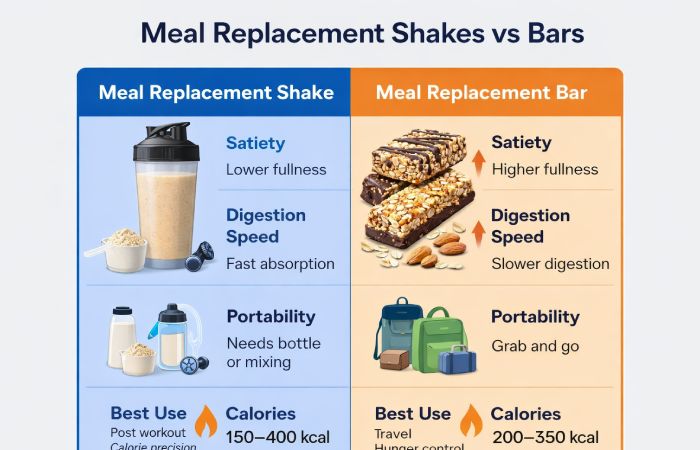
| Factor | Meal Replacement Shakes | Meal Replacement Bars |
|---|---|---|
| Satiety | Lower (liquid = less hormonal signal) | Higher (chewing activates CCK) |
| Digestion speed | Fast (liquid absorbed quickly) | Slower (solid digestion = sustained energy) |
| Calorie precision | High (mix your own ratio) | Medium (fixed per bar) |
| Portability | Medium (RTD bottles) / Low (powder) | Very High |
| Prep required | Yes (powder) / No (RTD) | No |
| Customizability | High (add ingredients) | None |
| Hydration contribution | Yes | No |
| Average cost/serving | $1–$3 (powder) / $3–$5 (RTD) | $2–$5 |
| Ideal use case | Post-workout, calorie precision, medical needs | On-the-go, travel, satiety priority |
Satiety and Hunger Control — Why Solid Food Wins
If you’ve ever had a meal replacement shake and been hungry again 60–90 minutes later, there’s a physiological reason. Liquid calories spend less time in the stomach and trigger fewer satiety signals than solid foods. Studies suggest that meals requiring chewing are associated with stronger and more sustained satiety signals, and hormones such as CCK play a role in this response.
Bars, by requiring physical chewing, engage this mechanism. That doesn’t mean bars are always better — just that if staying full is your primary concern, solid wins.
Digestion Speed and Nutrient Absorption
Shakes deliver nutrients faster. This is genuinely useful when you need rapid energy — such as after a workout when muscle protein synthesis is elevated. Bars digest more slowly, providing a steadier energy release that avoids the quick spike and crash associated with some high-sugar shakes.
Convenience and Portability
No preparation wins battles. In any situation where you can’t mix, blend, or refrigerate — traveling, commuting, hiking, outdoor events — bars are the default winner. Shakes in ready-to-drink form close the portability gap, but at a significantly higher per-serving cost.
Cost Per Serving Breakdown
| Format | Budget Range | Premium Range |
|---|---|---|
| Shake Powder | $1.00–$2.00/serving | $2.50–$4.00/serving |
| Ready-to-Drink Shake | $2.50–$3.50/bottle | $4.00–$6.00/bottle |
| Meal Replacement Bar | $1.50–$2.50/bar | $3.00–$5.00/bar |
Over a month (replacing one meal/day), the difference between shake powder and premium RTD or bars can exceed $60. That matters for long-term adherence.
Which Is Better for Weight Loss?
Neither format is inherently superior for weight loss — what matters is the caloric deficit, not the format. But each has practical advantages worth considering.
Calorie Control: Where Shakes Have the Edge
Powdered shakes allow you to measure exactly how many calories you consume. Add one scoop (typically 180–220 calories) to water for a lean replacement, or blend with milk and fruit for a fuller 350-calorie option. This flexibility makes shakes a go-to for anyone tracking macros with precision.
Long-Term Sustainability: The Satiety Factor
Here’s the trade-off: shakes may give you better calorie control, but if they leave you raiding the fridge 90 minutes later, that control is illusory. For many people — especially those new to meal replacements — bars reduce between-meal snacking because they keep hunger at bay longer.
The weight loss answer: Choose shakes if you’re precision-tracking calories and can tolerate liquid meals. Choose bars if satiety is your bigger challenge.
How to Read a Meal Replacement Label (3 Things to Check)
Before you buy anything labeled “meal replacement,” run this 3-check test:
- Check 1 — Calorie Range Is the product between 200–400 calories? Below 200 and it’s likely a snack. Above 400 and it’s approaching a full meal — fine for active individuals, but watch your totals.
- Check 2 — Micronutrient Coverage Look at the % Daily Value for vitamins and minerals. A true meal replacement should show ≥20–30% DV for most key vitamins (A, C, D, E, B12) and minerals (calcium, iron, magnesium). If the label is sparse here — it’s not a meal replacement.
- Check 3 — Sugar and Fiber Added sugar should be under 10g per serving for weight management goals. Fiber should be at least 3–5g to support satiety and digestive health. Avoid products whose primary sweetener is sugar alcohols (maltitol, sorbitol) if you have a sensitive digestive system.
Common Mistakes to Avoid
- Treating a protein bar as a meal replacement. Most protein bars are supplements — not meals. Check the micronutrient panel before assuming.
- Using either as your only meals long-term. Meal replacements work best as occasional substitutes, not permanent diet pillars. Over-reliance can lead to deficiencies in phytonutrients and diverse food compounds.
- Ignoring the sugar content. Some “healthy” shakes contain 20–25g of added sugar — more than a candy bar. Always read the label.
- Not accounting for satiety at the right times. Using a shake at breakfast (when you may be busy and not hungry yet) vs a bar at lunch (when you need to feel full through the afternoon) can dramatically affect how satisfied you feel.
- Buying premium without checking basics. Expensive does not equal nutritionally complete. A $6 artisanal bar may have less vitamin coverage than a $1.50 powdered shake.
Who Should Choose What — Decision Framework
Choose a Meal Replacement Shake if you:
- Work out regularly and need fast post-workout nutrition
- Want precise calorie and macro tracking
- Prefer liquid meals or have difficulty chewing
- Don’t mind carrying a blender bottle
- Want to supplement hydration during the day
- Are managing a medical condition requiring liquid nutrition
Choose a Meal Replacement Bar if you:
- Travel frequently or have a long commute
- Struggle with hunger and need longer satiety between meals
- Work in environments where a drink isn’t practical
- Prefer a solid food experience
- Want maximum grab-and-go simplicity
Consider neither (or consult a dietitian) if you:
- Plan to replace all meals with these products long-term
- Have a history of disordered eating
- Are pregnant or breastfeeding
- Have kidney disease or diabetes (macronutrient ratios are critical to manage carefully)
Final Verdict
Both meal replacement shakes and bars are legitimate tools — but they solve different problems.
Shakes are best for calorie precision, post-workout recovery, and those who prefer liquid nutrition. Bars are best when satiety, portability, and convenience are the priority.
The decision isn’t “which is better” — it’s “which fits your situation right now.” Many people keep both on hand: shakes for gym mornings, bars for travel days.
One rule applies to both: read the label. If a product falls well below the 200–400 calorie range and provides little in the way of vitamins and minerals, it is more likely a snack or protein supplement than a true meal replacement, regardless of the marketing.
Frequently Asked Questions
Q: Are meal replacement shakes or bars better for weight loss?
A: Both can support weight loss when used to control calorie intake. Shakes offer more calorie precision, while bars tend to provide better satiety — helping reduce snacking. The best choice depends on whether your challenge is tracking calories or controlling hunger.
Q: Can I use meal replacement bars as a complete meal?
A: Only if the bar qualifies as a true meal replacement — providing 200–400 calories and at least 20–30% of daily vitamins and minerals. Most protein bars and snack bars do not meet this standard. Always check the nutrition panel.
Q: Why do meal replacement shakes leave me hungry?
A: Liquid meals are digested faster than solid food and trigger fewer satiety hormones (such as CCK) because they don’t require chewing. If hunger is a problem, try adding high-fiber ingredients to your shake, or switch to a bar for that particular meal occasion.
Q: How long can I safely use meal replacements?
A: Meal replacements are generally intended to complement, not permanently replace, a varied whole‑food diet. Relying on them as your main source of food over the long term can reduce your intake of phytonutrients, antioxidants, and dietary fiber naturally present in minimally processed foods, so it is wise to discuss any long‑term plan with a registered dietitian or healthcare professional.
Q: What’s the difference between a protein bar and a meal replacement bar?
A: A protein bar is designed primarily to increase protein intake and often lacks sufficient calories, vitamins, and minerals to substitute a full meal. A meal replacement bar provides a balanced nutritional profile — protein, carbohydrates, fats, and micronutrients — intended to replace a complete meal. The nutrition label tells the difference.
About Marketingsguide
Marketingsguide publishes practical, easy-to-understand content on health, technology, business, marketing, and lifestyle. Articles are based mainly on reputable, publicly available information, with AI tools used only to help research, organise, and explain topics more clearly so the focus stays on real‑world usefulness rather than jargon or unnecessary complexity.
Disclaimer: This article is for informational purposes only and does not provide medical, nutritional, or professional health advice. Meal replacement products and diet changes can affect individuals differently, especially if you have existing medical conditions, are pregnant or breastfeeding, or take prescribed medication. Always speak with a qualified healthcare professional or registered dietitian before making significant changes to your eating pattern or using meal replacements regularly.