

Scroll through social media and digital nomad life looks like a dream — laptops by the pool, sunsets in Bali, cocktails in Lisbon. The reality? More like hunting for reliable Wi-Fi in a noisy café, managing time zones that wreck your sleep, and figuring out taxes in countries you can barely pronounce.
That gap between the fantasy and the grind is where most people get stuck. They either romanticize the lifestyle and burn out within months, or dismiss it as impractical without understanding how much it has matured.
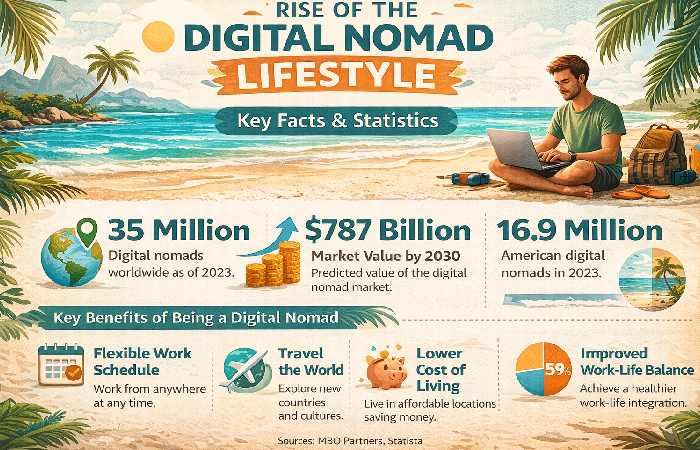
Various reports estimate the global digital nomad population in the tens of millions, with some studies putting it at around 35 million people worldwide. More than 50 countries now offer some form of digital nomad or remote work visa, according to recent global counts.And the dominant model is no longer “quit everything and wander.” For many people, a hybrid nomadism model — keeping a home base while traveling seasonally — is becoming the most common and sustainable pattern.
This guide breaks down what digital nomad life actually looks like today, how people fund it, where they go, what breaks them, and how to decide if it is right for you.
Table of Contents
Key Takeaways
- What is it? → Working remotely while living in different locations, enabled by technology and digital nomad visas.
- How do people afford it? → Remote employment, freelancing, online businesses — increasingly through hybrid arrangements with employers.
- Where do they go? → Portugal, Thailand, Colombia, and 50+ countries with nomad visas, each with different cost and infrastructure profiles.
- What is the hardest part? → Loneliness, tax complexity, and burnout — not money or logistics.
- Should you try it? → Yes, if you have stable remote income, 3–6 months of savings, and realistic expectations. No, if you are running away from problems.
What Is Digital Nomad Life?
The Definition
Digital nomad life is a lifestyle in which individuals use technology to work remotely while traveling or living in different locations around the world. It combines location independence — the freedom to work from anywhere with an internet connection — with deliberate mobility across cities, countries, or continents.
Unlike traditional remote work, which typically happens from a fixed home office, digital nomad life involves regularly changing your base. Some nomads move every few weeks. Others practice slowmading — staying one to three months in each place to build routine and deeper connections.
What a Typical Day Actually Looks Like

Forget the Instagram version. A typical day for most digital nomads in 2026 looks more like this:
- 7:00–8:00 AM — Wake up, find a co-working space or café with decent internet
- 8:30 AM–12:30 PM — Focused work block (synced with client or employer time zone)
- 12:30–2:00 PM — Lunch, explore the neighborhood
- 2:00–5:00 PM — Second work block, calls, admin tasks
- 5:00–7:00 PM — Exercise, sightseeing, or language practice
- Evening — Dinner, social meetup, or quiet night in an Airbnb
The reality is more structured than most outsiders assume. Successful nomads establish routine quickly in each new location — identifying their workspace, grocery store, gym, and social spots within the first few days.
How Digital Nomads Make Money in 2026
The days of scraping by on travel blog income are over. Digital nomads in 2026 earn through three main channels, and research from MBO Partners indicates that the majority now earn stable, professional-level incomes.
Remote Employment (Full-Time and Contract)
The largest share of digital nomads work as regular employees of companies that allow remote work. Software engineers, designers, marketers, project managers, and customer success professionals dominate this category.
To stay competitive in these roles, it helps to keep sharpening in‑demand remote work skills like digital literacy, communication, and problem‑solving as remote work continues to evolve.
Freelancing and Online Business
Freelancers on platforms like Upwork, Toptal, and Fiverr make up the second-largest segment. Writers, developers, video editors, and consultants find steady work this way.
Others run online businesses: e-commerce stores, digital courses, SaaS products, or content platforms. The common thread is that income is not tied to a physical location.
Hybrid Nomadism — The Emerging Default
Here’s something most digital nomad guides won’t tell you: you do not have to quit your job to live this way.
Hybrid nomadism is one of the most common ways people live a digital nomad lifestyle in 2026, especially among professionals with stable remote jobs. It means keeping a home base — an apartment, a family home, a storage unit — while traveling for chunks of the year. Maybe three months in Southeast Asia during winter. Six weeks in Portugal in spring. Then back home for the rest.
This approach eliminates the biggest risks: you maintain employer benefits, avoid extreme tax complexity, and preserve your social anchors. It is also the model most employers are willing to support.
Best Countries for Digital Nomads in 2026
Not all destinations are equal. The cheapest option is rarely the best. Safety, healthcare access, internet reliability, and visa terms matter far more than rock-bottom rent.
Here is a comparison of eight proven destinations based on typical 2026 cost ranges and infrastructure data reported by digital nomads and travel research. According to Forbes’ 2026 analysis of affordable digital nomad countries, several emerging destinations now rival traditional hubs in infrastructure and value.
| Country | Visa Type | Monthly Cost (USD) | Internet Speed (Avg Mbps) | Safety Rating |
|---|---|---|---|---|
| Portugal | D8 Digital Nomad Visa | $2,000–$2,800 | 85 | High |
| Thailand | Destination Thailand Visa | $1,000–$1,500 | 60 | High |
| Colombia | Digital Nomad Visa | $800–$1,200 | 45 | Medium |
| Spain | Digital Nomad Visa | $1,800–$2,500 | 100 | High |
| Georgia | Remotely from Georgia | $600–$1,000 | 40 | High |
| Indonesia (Bali) | E33G Remote Work Visa | $1,200–$1,800 | 35 | Medium |
| Mexico | Temporary Resident Visa | $1,000–$1,600 | 45 | Medium |
| Estonia | Digital Nomad Visa | $1,500–$2,200 | 90 | High |
Costs include rent, food, co-working, transport, and basic insurance. Actual costs vary by city and lifestyle.
Affordable Destinations With Strong Infrastructure
Georgia offers the lowest cost of entry with surprisingly good internet in Tbilisi. Thailand remains a favorite for first-time nomads thanks to its co-working ecosystem, affordable healthcare, and community events.
For those who need reliable infrastructure and EU access, Portugal and Estonia lead — both offer strong digital infrastructure and clear visa pathways.
Digital Nomad Visas Worth Considering
Most digital nomad visas require proof of:
- Remote income — typically $2,000–$4,000/month minimum
- International health insurance — usually $50,000–$100,000 coverage
- Clean criminal record
- Valid passport — at least six months validity remaining
Exact income thresholds, insurance levels, and paperwork vary by country and change over time, so always confirm current requirements with official government or consular sources before applying.
The application process generally takes two to eight weeks. As of 2026, Spain’s digital nomad pathway can be renewable for several years and may allow some applicants to access favorable tax regimes such as the Beckham Law, depending on their profile. Indonesia has also introduced an E33G remote work visa that permits extended stays with possible renewal, subject to evolving regulations.
The Real Challenges of Digital Nomad Life

This is the section most guides gloss over. But these challenges trip up more nomads than logistics or money ever will.
Loneliness and Social Isolation
This is the single most common complaint among experienced digital nomads — and it is the one nobody talks about on Instagram.
When you move every few weeks, friendships stay surface-level. You meet interesting people constantly but rarely see them again. Meanwhile, your friends at home continue building deeper connections without you.
What helps:
- Slowmad instead of fast-traveling — stay two to three months per location
- Use co-living spaces like Selina, Outsite, or local co-living houses
- Attend regular community events (Nomad List meetups, coworking socials)
- Schedule weekly video calls with close friends and family back home
Burnout and Work-Life Boundaries
Nomad burnout is real, and it comes from an unexpected place: decision fatigue. Every new city requires dozens of micro-decisions — where to stay, where to work, where to eat, how to get around.
Stack that on top of client calls at odd hours, and the “freedom” starts to feel exhausting.
What helps:
- Build a relocation routine: arrive, find workspace, stock groceries, explore on day two
- Set hard work hours — no “just one more email” at dinner
- Plan travel in advance rather than making last-minute decisions
- Take “stay weeks” — extended periods in one place with zero travel planning
Tax Compliance Across Borders
This is the sleeper risk of digital nomad life in 2026. Governments worldwide are tightening enforcement on remote workers.
The core issue: many countries consider physical presence when deciding whether you are a tax resident. In a lot of places, spending around 183 days or more in a country can trigger tax residency and potential local income tax obligations, even if your employer is based elsewhere.
Deel’s compliance guide on cross-border taxation notes that failing to comply can result in back taxes, penalties, and visa revocations. Some countries are now sharing data with each other to track worker movements.
What helps:
- Track your days in each country precisely (apps like Nomad Tax Tracker help)
- Consult a cross-border tax advisor before you leave — not after
- Consider the hybrid model — keeping tax residency in your home country while traveling within its thresholds
- Understand the specific tax rules of your destination (some nomad visas include tax exemptions)
Tax rules for remote workers and digital nomads are complex and changing quickly, so always get personalized advice from a qualified cross‑border tax professional rather than relying only on general guides.
How to Become a Digital Nomad (Step-by-Step)
Before You Leave — Financial and Career Prep
-
Consider basic networking assets. You do not need fancy branding, but you can design a simple business card to share with clients and contacts you meet in co‑working spaces or events.
- Build a savings buffer. Three to six months of living expenses, minimum. This covers emergencies, slow client months, and unexpected travel costs.
- Resolve your tax situation. Understand your home country’s rules on foreign-earned income and physical presence thresholds. Consult a tax professional.
- Get international health insurance. Standard travel insurance is not enough. Look for plans that cover medical evacuation, ongoing treatment, and mental health (SafetyWing and World Nomads are popular among nomads).
- Downsize deliberately. Sell or store belongings you won’t need. The lighter you travel, the easier transitions become.
Your First 90 Days on the Road
- Month 1: Choose a familiar, well-supported destination (Lisbon, Chiang Mai, Medellín). Focus on establishing a daily work routine.
- Month 2: Refine your workflow. Join co-working spaces. Attend a local nomad meetup or event.
- Month 3: Evaluate honestly. Is this sustainable for you? Adjust your pace, budget, or destinations based on real experience — not assumptions.
Essential Tools and Apps
| Category | Tools |
|---|---|
| Connectivity | eSIM (Airalo, Holafly), VPN (NordVPN, ExpressVPN) |
| Productivity | Notion, Slack, Zoom, Toggl |
| Finance | Wise (multi-currency), Revolut |
| Accommodation | Airbnb, Booking.com, NomadStays |
| Community | Nomad List, Facebook Groups, Meetup |
| Tax tracking | Nomad Tax Tracker, TaxScouts |
Common Mistakes New Digital Nomads Make
- Moving too fast. Changing cities every week leads to exhaustion, shallow experiences, and zero productivity. Aim for two to four weeks minimum per location.
- Ignoring taxes. “I’ll figure it out later” can mean five-figure tax bills and legal trouble. Address this before you leave home.
- Overestimating savings. Budget for the unexpected — visa fees, lost luggage, medical costs, laptop repairs. Your budget should include a 20% buffer.
- Choosing destinations by cost alone. The cheapest apartment means nothing if the internet drops every hour or safety is a concern.
- Neglecting relationships. Your social life does not maintain itself when you are on the move. Invest effort in staying connected with the people who matter.
- Working without boundaries. Without a clear start and stop time, work expands to fill every waking hour. Burnout follows quickly.
Who Is Digital Nomad Life For — and Who Should Avoid It
Best for:
- Remote employees with company-approved work-from-anywhere policies
- Freelancers and consultants with portable skill sets (writing, design, development, marketing)
- Couples or families seeking an intentional change of pace — especially with school-age children adaptable to homeschooling or international schools
- People who thrive on novelty, adaptability, and self-directed structure
Not for:
- Anyone fleeing problems at home — geographic change does not fix personal struggles
- People with zero savings or unstable income streams
- Those who need frequent in-person collaboration or client-facing roles
- Anyone uncomfortable with ambiguity, administrative complexity, or being alone
This is not a pass/fail test. Many people start with a trial run — a one-month remote work trip — before committing to longer-term nomadism.
Final Verdict — Is Digital Nomad Life Worth It?
For many remote workers, digital nomad life in 2026 is more accessible, more structured, and more nuanced than ever. It is no longer the wild‑west experiment it felt like a decade ago: visa programs exist, tools are mature, and global nomad communities are well established.
But it is also harder than social media suggests. Loneliness, tax headaches, and decision fatigue are genuine costs that the glossy content skips over. The people who thrive are not the most adventurous — they are the most organized, honest with themselves, and deliberate about how they design their routines.
Practical recommendation: If you have stable remote income and three to six months of savings, try a one-month test run in a well-supported destination before making any permanent changes. Digital nomad life does not require burning bridges. The hybrid model lets you test, learn, and adjust without gambling your financial stability.
Frequently Asked Questions
Q: What is a digital nomad?
A: A digital nomad is someone who works remotely using technology while living in different locations, rather than committing to a single fixed home. The lifestyle combines location independence with deliberate travel or relocation.
Q: How do digital nomads make money?
A: Most digital nomads earn through remote employment, freelancing, or running online businesses. Common roles include software development, writing, design, marketing, and consulting. In 2026, the majority hold regular remote jobs rather than freelancing full-time.
Q: How much does digital nomad life cost per month?
A: Monthly costs vary widely by destination. Budget-friendly locations like Georgia or Thailand allow comfortable living for $800–$1,500/month. Western European cities like Lisbon or Barcelona often require $2,000–$3,000/month including co-working, rent, food, and insurance.
Q: Which countries offer digital nomad visas in 2026?
A: Over 50 countries now offer dedicated digital nomad visas, including Portugal, Spain, Thailand, Estonia, Colombia, Indonesia, and Georgia. Most require proof of remote income ($2,000–$4,000/month), health insurance, and a clean criminal record.
Q: Is digital nomad life lonely?
A: It can be. Loneliness is the most frequently cited challenge among experienced nomads. Constant movement makes deep friendships difficult to build. Strategies like slowmading, co-living, community events, and regular calls with family can help significantly.
Q: Do digital nomads pay taxes?
A: Yes. Most countries tax based on physical presence. Spending more than 183 days in a single country can trigger local tax residency. Digital nomads should track their days carefully and consult a cross-border tax professional to avoid penalties.
Note: Visa rules, tax laws, and income thresholds for digital nomads change frequently, so always verify details with official government sources or qualified professionals before making decisions.