

You’ve heard the pitch before. “Build once, deploy everywhere. Save 40% on costs. Launch in half the time.” For some projects that level of savings is possible, but it is not a guaranteed outcome for every app.
It sounds almost too clean. And honestly? For the right project, it’s pretty close to true. But for the wrong one? Cross-platform can create more problems than it solves — and no agency pitch will tell you that upfront.
This guide draws on Garage2Global’s experience delivering cross-platform projects and covers the topic without the sales filter. What cross-platform actually means from a technical point of view, what frameworks Garage2Global uses and when each one of them is a logical fit, what you‘ll actually end up paying and equally important in which cases native development is better.
Whatever you‘rea founder figuring out how to build your first app or a product manager trying to decide between agencies here‘s the breakdown you need before you sign.
Table of Contents
Quick Answers Before You Dig In:
- What is it?-> Cross-platform development builds one application that can run on iOS, Android and (more often than not) the web of i using a single shared codebase.
- Which platforms does Garage2Global use?-> Flutter, React Native, Xamarin/. NET MAUI, and PWAs selected on a project basis according to the particular needs of the project.
- What does it cost?-> App sangevaries ‘15,000… $150,000+ ’ depending on how complex it is; cross-platform development can often bring overall effort below that of two native apps, since you don‘t need to build or maintain both.
- Is cross-platform always better?-> No hardware intensive or GPU heavy apps still often benefited from native development
- Who is this best for?–> Startups with MVP‘s, SMBs requiring multi-platform reach, and enterprises seeking to standardize on internal tools across device types
What Is Cross-Platform App Development?
Cross-platform app development refers to producing a single mobile application with a common code base for it all to function across a variety of operating systems (viz. IOS, Android and Web where possible) natively (or near-natively). For this purpose, the developer uses specific frameworks to bridge/compile the base code.
And that last sentence is more important than most guides admit. By “cross-platform,” it doesn‘t mean “Wrapper around a browser.” Natively implemented, modern frameworks like Flutter and React Native use native components or their own fast rendering engines to draw.
Native vs. Hybrid vs. Cross-Platform — What’s Actually Different?
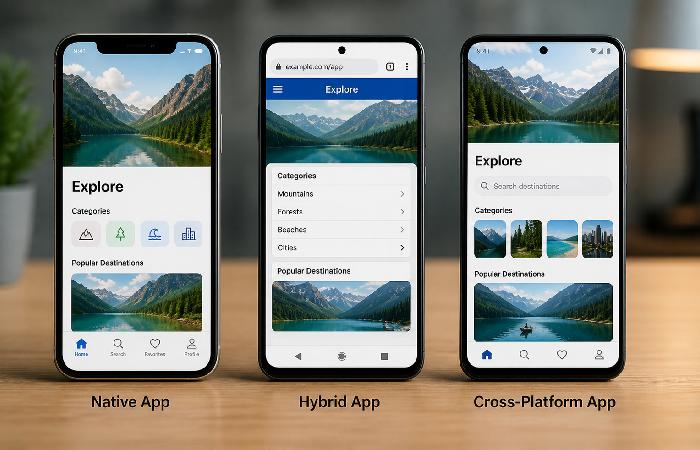
People use these terms interchangeably. They shouldn’t.
| Approach | How It Works | Performance | Cost | Best For |
|---|---|---|---|---|
| Native | Separate codebases per platform (Swift/Kotlin) | Highest — full platform access | Highest — two full builds | GPU-heavy apps, platform-specific features |
| Hybrid | Web app wrapped in a native shell (Cordova, Ionic) | Lower — runs in a WebView | Low | Simple internal tools, content apps |
| Cross-Platform | Single codebase compiled or bridged to native components | Near-native to native | Medium — often lower than building two native apps | Most business apps, MVPs, SaaS tools |
So when Garage2Global describes their work as cross-platform, they’re not building a website with a native wrapper. They’re using production-grade frameworks that generate genuinely performant apps — with real, honest caveats on where the ceiling sits.
Why Businesses Choose Cross-Platform in 2026
The Cost and Timeline Reality
Most teams see a clear financial benefit in cross-platform development, often saving a significant amount of money versus developing separate native Android and iPhone applications with a common code base, a smaller team, and simplified testing.
That’s real. But the savings aren’t just upfront.
Here’s the angle most agencies skip: the maintenance side. With native development, every bug fix, every new feature, every OS update gets coded twice — once for iOS, once for Android. With a shared codebase, you do it once.
In our experience, over a 3‑year product lifecycle that maintenance delta can, in many cases, exceed the initial build cost savings on similar projects. That’s the TCO argument, and it’s the one that actually moves the needle for companies thinking long-term.
Native vs Cross-Platform Over a 3-Year Lifecycle
Look beyond the initial build and consider where the effort actually goes:
The long-term savings on maintenance and feature work for many business applications will actually outweigh the initial build number on the proposal.
On timelines: Cross-platform can mean a huge reduction in app development time over having two native tracks, which is a nigh-on essential advantage for any speedy launches, for MVPs and startups that are looking for traction quickly. For example, a year spent building two native apps could be an eternity to a startup who ships a cross-platform alternative a year earlier.
But. And this is worth stating plainly — cross-platform doesn’t automatically mean fast. Poorly scoped projects, unclear requirements, or choosing the wrong framework for the job can kill any timeline advantage. Speed comes from good process, not just the technology choice.
What the Market Data Actually Says
Public developer surveys and ecosystem reports indicate that cross-platform frameworks have maintained a healthy growth among the widespread industry adoption where in such samples like both the 2024 Stack Overflow Developer Survey and JetBrains State of Developer Ecosystem 2024 you will see the use of modern frameworks and libraries at all levels of the web and mobile stack remains healthy and consistent. Flutter and React Native are ranking always in the top 5 of the most widely used cross-platform frameworks globally so this is exactly what Garage2Global vision was built on.
Official framework documentation and showcase galleries also reveal hundreds of production use cases across consumer, finance and SaaS applications.
Today‘s leading consumer, finance, and SaaS apps are running in React Native and Flutter in production, so its usage is no longer limited to prototypes and experiments in fact, they‘re used primarily for MVPs.
Garage2Global’s Cross-Platform Development Approach
Here‘s the important part: not what they build but how they chose what to build and why. Before any code‘s written, there should already be a conversation about ‘which’ framework.
Discovery and Strategic Planning
With most of our Garage2Global projects, our process begins at discovery mapping out our client‘s targeted audience, must-have features, platform needs, and business objectives. This is the phase in which most builds tend to thrive or flop in silence. Agencies that move through or avoid discovery will default to a framework that meets their team‘s current limitations.
A few questions worth asking any agency at this stage:
- Which is your go-to framework and why?
- Why would you recommend the native route over cross-platform?
- What do you do for platform-exclusive features such as Bluetooth, NFC, or AR?
If an agency can’t answer the second question clearly, that’s a signal.
Technology Selection Logic
Garage2Global’s framework selection isn’t one-size-fits-all — or at least, it shouldn’t be. Each framework has real strengths and real limits:
| Framework | Owned By | Best For | Watch Out For |
|---|---|---|---|
| Flutter | Pixel-perfect custom UI, animation-heavy apps, fast performance | Larger app size; smaller native library ecosystem vs. React Native | |
| React Native | Meta | Apps needing large ecosystem support; JavaScript-native teams; proven scale | Performance ceiling on very complex animations; requires native modules for some hardware |
| .NET MAUI (Xamarin) | Microsoft | Enterprise apps in .NET ecosystem; Windows + mobile targets | Smaller community; fewer third-party packages than Flutter/RN |
| PWA | Web standard | Content-first apps; low-budget, wide-reach; no app store required | Limited hardware access; no offline-first capability without significant engineering |
Kotlin Multiplatform is getting more popular in 2025–2026. It‘s created by JetBrains, lets you share business logic between platforms without forcing you to share native UI, but the ecosystem is a little less mature than Flutter or React Native for certain scenarios on iOS. It‘s not in the Garage2Global main stack right now but still a good thing to ask around if you want native UI alongside shared business logic on an enterprise application.
Design, Build, and Testing
Cross-platform development doesn‘t mean that your UX team can “design once, ship everywhere.” Platform design conventions are different: iOS users see bottom-tab navigation and swipe-back; Android users see navigation patterns based on material design differences. A reputable experienced cross-platform team will plan for platform differences during UX and UI design, not during QA:
Agile sprint methodology — short development cycles with client review points — is the standard for serious cross-platform builds. It lets teams catch requirement mismatches before they become expensive rebuilds.
Deployment and Post-Launch Support
Both Flutter and React Native apps submit through the standard App Store and Google Play review processes. There is no shortcut on that front.
The App Store Reality for Cross-Platform Apps
Cross-platform frameworks do not give you a shortcut around Apple or Google’s review rules. The main approval risks usually come from how you handle permissions, data collection, payments, and policy compliance — not from whether you used Flutter, React Native, or native code. A good partner will design your flows and disclosures with these review guidelines in mind so you are not surprised late in the launch process.
Post-launch, a shared codebase genuinely does simplify maintenance — one team, one update cycle. That simplicity compounds over time.
There are some basic tests you can do to minimize delivery risk before you sign any of these cross-platform partners:
- Request live apps you can actually try out yourself, and not just static screenshots on a slide deck.
- Watch that they are consistent between what they say on their web site, the content of proposals you see and the things you hear on calls. For example around timelines and results.
- If you can, speak to at least one of the recent clients of a similar size or complexity, and find out how well communications changed management, and post-implementation support really worked.
- Written confirmation that you will be listed as owner of the codebase, assets, and core infrastructure accounts so that you are not locked into one vendor.
- Define what is provided by post-launch support, what is excluded from the scope, and how priority is assigned to urgent production issues.
A management team that is willing to answer those questions forthrightly is almost always a better long-term partner for a company than a management team that relies totally on puffery.
Questions to Ask Before You Sign
- Group your questions into a few core areas:
Technique fit: Which one(s) would you choose for the project and why? What about any native modules we‘d potentially require? - Delivery process: How will the sprints, demos and feedback look like? Who will be our main contact?
- Ownership & IP: What ownerships are transferred? Who owns the code bases, designs and infrastructure accounts?
- Quality and testing: What kind of testing do you do before release (unit testing/integration/device/performance tests)? On which devices do you test?
- Maintenance and support: What does your post-launch support cover, what doesn‘t and how are emergency production issues dealt with?
- Change management: What is your plan to manage scope creep once the actual development begins. How will this impact the budget and time schedule that we would see?
Red Flags in Cross-Platform Proposals
A few patterns should make you pause before signing:
- A fixed quote is provided without a proper discovery or scoping phase.
- The proposal never mentions native modules, even though your project depends on hardware features or advanced integrations.
- There is no clear description of testing practices, device coverage, or performance targets.
- Code ownership and access to repositories, accounts, and assets are not explicitly defined.
- Cross platform is always cheaper and faster in the eye of the agency, without ever considering that there are edge cases.
- The agency claims cross-platform is always cheaper and faster in every scenario without acknowledging edge cases.
The Technology Stack — How Garage2Global Chooses Frameworks
Flutter — Best For
Polished applications where pixel perfection between Ios and Android version is important. Flutter provides this ability because it does not use native UI elements, instead Flutter has its own rendering engine called Skia/Impeller that makes the app look the same in both OS and on any device which is perfect for brand focused applications. It can sometimes look a little “alien” to the native look of a platform which could be an issue for utility enterprise apps.
Flutter is one of the most widely used frameworks when building multi-platform apps and it is both fast and productive. Being an open-source framework for developing multi-platform apps that are compiled to native code, it will probably stay among one of the leading frameworks for many years.
React Native — Best For
Apps that need to look really native on both platforms, and can leverage a huge JavaScript ecosystem. React Native renders with true native UI components so it looks native on each platform automatically. That‘s a selling point for apps where native UX patterns are a factor in user adoption. It‘s used in production at Facebook, Instagram, Shopify, and Microsoft Teams. That‘s not a small proof point.
.NET MAUI / Xamarin — Best For
Enterprises already on the Microsoft stack. If your backend is. Net, your team is writing in C#, you‘ve got to target Windows as well as iOS and Android MAUI makes sense. It‘s not as eye-catching as Flutter, and it doesn‘t have the big community behind it, but for the right enterprise use-case it‘s the most pragmatic.
Progressive Web Apps (PWAs) — Best For
Content-centric experiences where the ability to deploy via the app store is not essential and cost is tight. PWAs are web applications that have been “installed” onto a device homescreen and utilized off-line. Whilst they do not have access to the full spectrum of device hardware and their performance ceiling is technically lower than framework-compiled applications, they are an acceptable choice for anything that requires a news app or a relatively straight-forward service directory. For anything that is device-hardware intensive or feature-heavy, they are frequently the “transitional mode” rather than the end goal.
Best Framework by App Type
Here is how the main frameworks typically line up against common app scenarios:
These are patterns, not hard rules, but they provide a useful starting point for most projects.
When Cross-Platform Is the Right Call — And When It Isn’t
No agency will ever say your project isn‘t cross-platform. That‘s un-objective they‘re selling something. So here we are, the real figures.
Cross-platform is a strong fit for:
- Startups working on developing an MVP and require validation of a product idea across both iOS and Android without the resources to fund two separate builds.
- SMEs and mid-market customers with multi-device users requiring feature parity without doubling dev headcount
- Enterprise teams developing internal tools or productivity applications where a consistent user experience across devices is more important than platform-specific native feel, (e.g. uploading and sharing videos from a mobile device).
- SaaS products with companion mobile apps — where the web app is primary and mobile extends the experience
For instance, a SaaS business that has a mature web application and is looking to provide its product management and room notificationing to its users on mobile is probably a perfect as a platform-agnostic candidate.
A warehouse or logistics scanning app where your heavy use of rugged devices, proprietary scanners or other special hardware integrations may be a candidate for a native-first approach. An internal employee portal within a large organization that‘s already on the Microsoft stack may make a candidate to leverage . NET MAUI especially where you need to support windows as well as mobile.
Proceed with caution if:
- Your app need long and custom integration into device hardware (BTLE protocol, NFC, High Fidelity AR) some native modules already exist, but they will increase complexity and cost.
- Your user experience design is very much related to platform-specific interaction paradigms (iOS haptics ecosystem, Android back-gesture navigation)
Native is genuinely the better call when:
- You’re building a game or graphics-intensive application — Unity or native rendering still outperforms cross-platform frameworks on GPU workloads
- Platform-exclusive features are core to your product (Apple’s ARKit, Android’s Nearby API at depth)
- Your team is already native-first and the refactor cost of switching to cross-platform exceeds the savings
That last one matters. Cross-platform saves money when you’re starting fresh. For a mature native codebase, the migration cost often outweighs the benefit.
Should You Choose Cross-Platform or Native?
Use this quick matrix to see which direction is more practical for your project:
| Factor | Cross-Platform Usually Wins When… | Native Usually Wins When… |
|---|---|---|
| Hardware access | You only need standard device features (camera, basic sensors, push notifications) with a few targeted native modules. | Your app requires complex, deep, and custom integrations (which you haven‘t replicated on the existing platforms). |
| UI and animation | You need polished, responsive UI with some animations, similar to most business and consumer apps. | You push “high-end” graphics, complex real-time animation, or game-like interactions that tax the GPU. |
| Budget | You want to cover iOS and Android without funding and staffing two fully separate native teams. | Your budget is for two mature native teams and the ROI warrants the additional expenditure |
| Timeline | You need to get to market quickly on both platforms with shared logic and features. |
You‘re developing an enterprise single-platform flagship experience that it is more important for your team to execute on platform-specific best practices than to ship concurrently.
|
| Team skills | Your team or partner has strong JavaScript/Dart/C# skills and is comfortable bridging to native where needed. | This option is appealing for your team because you are already heavily invested in Swift/Kotlin. |
| Long-term maintenance | You want one shared codebase for most features, with limited native modules where necessary. |
You expect to see very heavy divergence on features and UX on iOS vs Android.
|
Generally speaking, if most of your answers are clustered toward the left, then cross-platform is usually the more conservative option. If you‘re perennially toward the right hand side, then you‘d probably do better going native in the long run.
When Cross-Platform Fails in Practice
Cross-platform usually fails for one of a few repeatable reasons:
- Choosing it for a hardware-heavy app where complex BLE, NFC, or sensor logic is core to the product and native modules grow out of control.
- Underestimating how much native module work is required and discovering late that 30–40% of the app is effectively native anyway.
- Assuming that one design will work perfectly on both platforms and ignoring platform-specific UX conventions until very late in the build.
- Ignoring app size and performance constraints and only discovering issues on mid-range or older devices during late-stage testing.
- Moving a mature native app to cross-platform is ultimately a decision to make without a well-defined ROI model and it will burn months of engineering time to achieve a marginal improvement.
Cross-Platform App Development Cost and Timeline
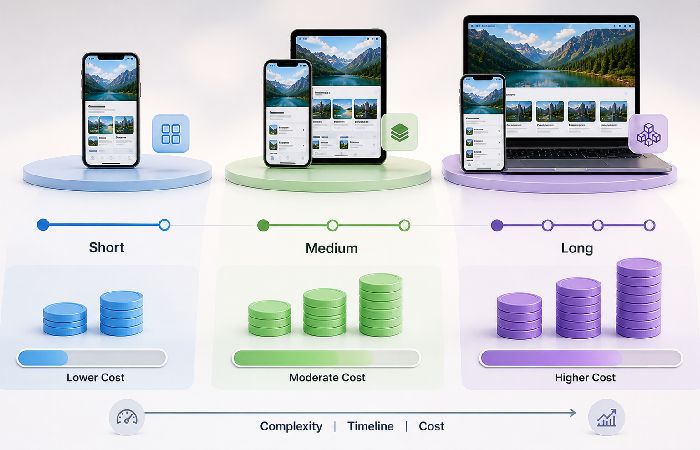
What Affects Your Cost
No agency should quote you a single price without knowing fully what you want. The biggest cost determinants are:
- Feature complexity: Integration with real-time data, payment processing, third-party API, or offline sync cost additional engineering hours.
-
Design requirements: Special animations and UIs cost excess.
- Backend scope: Is the backend included? Cloud infrastructure? API development?
- Platform targets: iOS and Android only, or web and desktop as well?
- Post-launch scope: Ongoing maintenance contract or a full handoff?
What Your Estimate Should Be Based On
Before you rely on a quote be sure your partner has asked and kept a record of the straightforward answers such as:
- What authentication will you require: email/password, SSO, social login or multi-factor authentication?
- Are you implementing live features like chat, real time:
- Note: (if you don‘t know what this last options means it‘s not that important)
- Will the APP require offline support, background sync or is it always online?
- What types of payments are considered in scope? Single transaction, subscription, in-app purchase or external payment gateway?
- Would you like an admin panel/back office tools with your mobile?
- What third-party integrations are necessary: analytics, CRM, marketing, maps, messaging, storage, or search?
- Are any security or compliance requirements, such as industry standards, local data laws?
- What is the expected level of analytics & event tracking at launch?
- Are you going to send a push notification, in app message or both?
- What hardware features includes the camera, GPS, biometrics, Bluetooth, NFC or sensors.
- What comprises post-launch support and within what time frame should production issues be resolved?
If a proposal avoids most of these questions, the estimate likely has not dug deep enough to be useful for serious planning.
Realistic Pricing Ranges
| App Type | Estimated Range | Timeline |
|---|---|---|
| Simple MVP (core features, 2 platforms) | $15,000 – $35,000 | 8–14 weeks |
| Mid-complexity business app | $35,000 – $80,000 | 14–24 weeks |
| Full-featured enterprise app | $80,000 – $150,000+ | 24–40+ weeks |
These are general industry ranges. Actual quotes will be here or there depending upon scope specifics. Even a ballpark should always be preceded with a thoughtful scoping conversation before heading down a price road map. Consider using these figures as a general guide rather than gold, as integrations, security needs, and design thoroughness change the bottom line.
The cost of the initial project quote is just a fraction of what you‘ll spend during the life of the app. If you‘re interested in a more well-rounded expected total cost of ownership, time to plan for:
- Ongoing maintenance (e.g. updates to the OS released, deployment of security patches, incremental changes for small features) these can start to accumulate over time. A lot of teams will allocate part of the costs of the initial build for each year for upkeep.
- Infrastructure and third-party services: Cloud hosting, databases, logging and monitoring, and third-party APIs such as payments, messaging, maps bring ongoing monthly or Usage-based costs.
- Store and ecosystem fees: Developer accounts, app review, and in some cases in-app payment revenue share should be included in your financial model.
- Change and scope buffer: Real users will reveal new requirements when the app reaches them. Retaining a small contingency in the budget allows response to be quick and not dangerous to the roadmap.
Getting either of your partners to identify these ongoing costs at the beginning will give you a far more sensible picture of your overall requirements than simply focusing on the initial build line item.
How Features Push Your Budget Up
You can think of feature-driven cost in rough bands rather than exact numbers:
| Feature Area | Typical Impact on Budget | Notes |
|---|---|---|
| Basic auth, simple forms, static content | Low | Forms, basic profiles, and simple lists are usually the cheapest features. |
| Payments and subscriptions | Medium | Payment gateways, refunds, and edge cases add integration and testing time. |
| Maps, location, and geofencing | Medium | Requires extra UX work, permissions handling, and performance tuning. |
| Real-time chat or live updates | Medium–High | Presence, typing indicators, read receipts, and push notifications all add complexity. |
| Offline mode and sync | Medium–High | Conflict resolution, background jobs, and data integrity must be designed carefully. |
| Admin dashboards and reporting | Medium–High | Separate UX, role-based access, and additional API design are often required. |
| Deep hardware features (BLE, NFC, custom sensors) | High | Native modules, device testing, and edge-case handling can grow quickly. |
| Advanced animations and custom interactions | High | Fine-tuned animations are time-intensive to design, implement, and test. |
This isn‘t a literal calculator, but it gives some idea of why two projects with the same number of screens might fall into two quite different budget ranges.
Timeline Reality Check
Most typical cross platform apps take around 8–12 weeks to deliver depending on scope. That is based on a reasonably well defined scope document, short feedback iterations from the client, and a fixed scope throughout the development sprints. If any of these factors go out then the timeline extends, sometimes significantly, so if you need a realistic target go for the longer estimate.
Common Myths About Cross-Platform Development
Myth 1: “Cross-platform apps are slow.”
This was somewhat the case six years ago. It‘s not meaningfully the case for most app categories in 2026. Several today popular cross-platform solutions like React Native, XPlat, Flutter, and Kotlin Multi-Platform offer you performance in the realm of native apps in many common use cases. Different industry case studies suggest that teams can halve development time if they unify their work into a single shared codebase while holding the user experience consistent. The difference can only be felt at the extreme end that‘s highly complex 3D rendering, and no doubt extremely fast GPU-powered workloads. For most business or consumer applications, users are unlikely to be able to distinguish.
Myth 2: “You can’t build complex features cross-platform.”
Incorrect. React Native and Flutter both allow native modules write a section of code in swift or kotlin that works seamlessly with the cross-platform layer. It‘s additional engineering effort compared to shared code but it means just about any feature can be implemented. The doomsday scenario: native integrations that are complex enough to undercut savings. You aren‘t “building once” when 30% of your features are native modules.
Myth 3: “Cross-platform only makes sense for prototypes.”
Facebook, Instagram, Shopify, and Microsoft Teams all run on React Native in production. That’s not prototype territory. The “just for MVPs” misconception comes from the early days of hybrid development (Cordova, PhoneGap) — a different technical approach that genuinely had production limitations. Modern cross-platform frameworks have a separate, higher performance profile.
Myth 4: “Native always has the edge.”
In some categories, yes. In most categories at scale, the edge is narrower than the cost difference justifies. The ‘correct’ question is never ‘which is better technologically?’! It is always ‘which one is right for the needs of this specific product’!
Frequently Asked Questions
Q: Is cross-platform app development right for a startup with a limited budget?
A: Usually, yes but not without a warning. If being the core product differentiator for your art & game apps depends on deep native platform integrations (AR, Bluetooth protocols, intense sensors access), account for native module price tags before locking into a cross-platform estimate. SaaS, ecommerce, productivity, content apps? Cross-platform will be the smart choice at early stage.
Q: How does Garage2Global decide which framework to use for a project?
A: Your framework choice should have three considerations: complexity of UI and how strongly it leans towards design/customization (Flutter wins), experience/needs of the team/environments (JavaScript application ecosystem wins, considering React Native), and environment of the backend/site (a Microsoft stack would lean towards MAUI). The only thing that a framework specific agency would Win on, is boring your choices to just one.
Q: Can an existing native app be converted to cross-platform?
A: Technically yes. Practically, it depends. If your native app is small, a rewrite in Flutter or React Native is often faster than a true migration. If it’s large and mature, a full rewrite is a significant project — and the cost may exceed what cross-platform would save you going forward. A phased approach (new features in cross-platform, legacy native code maintained) is worth exploring for larger apps.
A Quick Migration Readiness Check
If you already have a native app, ask yourself:
- What is the scale and size of existing code? How many are users and activity?
- How comparable today iOS and Android versions are in terms of features and UX?
- How much of your business logic could realistically be shared across platforms?
- Are there known performance or stability issues in the current native apps?
- How often do you ship new features? How frequently do requirements change?
- What about in-house developers who understand the native code? Or is it a black box?
- Are there future functionalities which would be easier to implement in a cross platform shared layer?
- How much risk can you accept in terms of regressions during a migration period?
Based on the answers to the above questions, a conclusion can be drawn whether full rewrite, stepping stone process or native is the more practical way.
Q: What does post-launch support typically look like?
A: Bug fixes, OS version compatibility updates (iOS and Android both release major versions annually), feature additions, and performance monitoring. With a shared codebase, these are handled once rather than twice — that’s where long-term maintenance savings are most visible. Ask any agency upfront: what’s included in post-launch? What’s billed separately? Get that in writing.
Q: How secure are cross-platform apps compared to native?
A: The framework applied is not a security decision the implementation is. The security is still needed and they should be using industry standard encryption for data in transit and storage, the privacy legislations provided (such as GDPR), and access control mechanisms should be implemented according to the data and the user roles accordingly.
What questions should be posed to any agency? How do you secure data in motion and rest? How do you manage authentications? Are you following the related data protection legislation for your users? These are implementation, not framework, questions. When in doubt consult the security recommendations document a cloud vendor or identity platform and factor these into your architecture decisions.
Final Verdict: Is Cross-Platform App Development by Garage2Global Right for Your Business?
Cross-platform app development — done properly, with the right framework selection for the right project — is often one of the most efficient ways to build a mobile product in 2026. The technology is mature. The market adoption is real. The cost and timeline advantages are genuine.
But “cross-platform” isn’t a category where all implementations are equal. The difference between a well-built Flutter app and a poorly scoped React Native app isn’t just about frameworks — it’s about discovery, planning, framework selection logic, and whether the agency building it treats your product requirements as the starting point or their preferred stack as the starting point.
Generally cross-platform is the best choice for most startups, small and medium size businesses, and large companies that are creating generic business applications. If your project demands what are natively exclusive to platform: GPU-heavy rendering, intrusive hardware use, special features…reach into the native SDK whether it requires more money up front or not.
The ideal result is always going to be the one where the correct tools are applied for your actual product. Have a thorough scoping discussion before anything is set in stone.
A Quick Decision Checklist
-
What is the degree of comfort with the primary language (say, Dart, JavaScript/TypeScript, C#) the framework is built upon that team members have?
- How mature are the plugins/libraries for your ‘must have’ features, e.g. payments/maps/analytics/authentication?
- How sophisticated is the UI and animation layer you are planning relative to a standard business application?
- Describe the amount of timeline pressure you are under to deliver the first production release:
- Who will take ownership of long-term maintenance (bugs, updates, dependencies reviews) once the app is live?
If there is a solution or framework that is definitely the winner by scoring well on these questions then that‘s the practical one to start with.
For further reading on framework technical documentation, see Flutter’s official developer documentation and React Native’s architecture guide for independent technical reference.