

You’ve probably noticed it. Search for anything related to SEO services right now and “SEO by HighSoftware99.com” keeps showing up — in blog posts, Reddit threads, comparison articles, even Google’s AI Overview. But here’s the frustrating part. Most of those results are either repackaged marketing copy or thinly disguised promotional content. Finding an honest, independent breakdown? Surprisingly difficult.
So we did structured desk research instead: we went through the official HighSoftware99 sites, bought up several thirdparty articles/discussions and verified all their claims against official documents from Google and accepted seo best practice.
This is an overview of the service: what the service actually does, where it is doing genuine SEO work, where it is raising red flags and whether it it makes sense for you.
Methodology note: This evaluation is based on publicly available content across HighSoftware99’s official web properties, independent third-party reviews, and cross-referencing against Google’s published Search Central documentation and spam policies. We haven’t used the service firsthand, and we have no affiliate relationship with any SEO provider mentioned.
This analysis is written from the perspective of long‑term SEO practice: interpreting how a service’s claims line up with publicly available Google documentation, common SEO workflows, and what typically works for small business and affiliate sites in real‑world search results.
Table of Contents
Why This Keyword Keeps Following You
If you’re seeing “SEO by HighSoftware99.com” everywhere, it’s not an accident. The brand has optimized for its own name across multiple domains and articles, and it’s increasingly referenced in AI‑generated overviews of SEO services, so anyone researching SEO providers naturally stumbles across it. That makes an independent, expectation‑setting review like this especially important before you let the repetition of the name influence your decision.
Quick Answers (Skim This First)
| Question | Short Answer |
|---|---|
| What is it? | A branded SEO service built around structured content, semantic optimization, and accelerated indexing — marketed as a faster path to visibility. |
| Does it work? | The structural and technical parts reflect standard SEO practice; the “instant” claims are where things get murky and need scrutiny. |
| Is it safe? | Potentially, if tactics stay within Google’s guidelines; autocomplete or query manipulation crosses into spam‑policy risk. |
| Best for | Small sites in low‑competition niches that need basic SEO structure at accessible pricing. |
| Skip it if | You need durable rankings in competitive markets or full‑service, authority‑building SEO. |
What Is SEO by HighSoftware99.com?
This section covers what the service claims to be and how it positions itself against conventional SEO providers.
SEO by HighSoftware99.com is a branded search optimization service that focuses on structured content architecture, semantic SEO, and accelerated indexing to improve search visibility. It aims to be a quicker option to traditional SEO agencies. Certainly how much quicker and at what expense is still subject to discussion across the Search Engine Optimisation community.
The service is provided through a number of linked web properties; seobyhighsoftware99.com, highsoftware99.com, seoservicehighsoftware99.com, and highsoftware99.org each targeting a few subtly different facets of the same whole. Worth mentioning, this multi domain strategy is a common effort to take up more than one slot on the search result page of the targeted brand name and is a reasonable practice.
The Core Claim — Structured SEO for Fast Visibility
The pitch boils down to this: instead of waiting months for traditional SEO to produce results, HighSoftware99 promises faster search visibility through better page structure, cleaner technical foundations, and optimized indexing signals.
On paper, none of that is controversial. Structured content and technical SEO are foundational best practices endorsed by Google’s own documentation on how search works. But the gap between “we help with structure and indexing” and the marketing language some associated pages use — phrases like “rank in hours” and “500% traffic growth” — is where skepticism becomes appropriate.
So what’s real and what’s marketing? The structured content component appears genuine. The speed claims need serious qualification. And the autocomplete-related promises sit in a gray area that could create real problems for your site.
How It Differs from Traditional SEO Agencies
Standard SEO agencies provide a wide range of services: keyword research, content development, link building, audits, reports, 6 or 12 months strategic planning. They‘re offering a process that‘s going to last over time.
HighSoftware99 positions itself differently. The emphasis is on fast indexing, specific tactical wins, and accessible pricing — what some industry observers call “starter SEO” or “visibility-first SEO.”
Here’s where that distinction matters in practice:
| Factor | Traditional SEO Agency | SEO by HighSoftware99.com |
|---|---|---|
| Timeline to results | 3–12 months | Claims of days to weeks |
| Primary focus | Authority building + content | Structure + indexing speed |
| Service scope | Full-service (content, links, technical, strategy) | Narrower (structure, technical, indexing) |
| Pricing | Typically $1,000–$10,000+/month | Marketed as “pocket-friendly” |
| Risk profile | Lower (when using white-hat methods) | Variable — depends on specific tactics |
| Long-term value | Builds owned assets (content, domain authority) | Unclear — may depend on continued service |
That comparison isn’t meant to declare one approach universally better. It’s context-dependent. But you should understand what you’re trading off before committing budget to either path.
How Does SEO by HighSoftware99.com Actually Work?
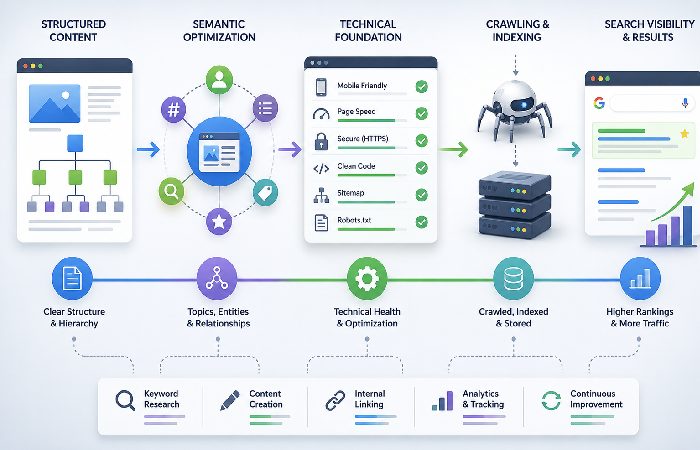
Ever wondered what‘s actually going on in the background of all the marketing language? Here we split the methodology apart in its bits, so you can evaluate each component separately.
Structured Content Architecture
The single best thing that both official and unofficial sources have said! Very simple concept structure your web pages by using a sensible heading hierarchy (H1, H2, H3), logical paragraph flow, and distinct topical sections so search engine spiders can make their way through the content easily.
This is good, accepted and non-controversial SEO strategy. Google Search Central‘s own guides also cite the importance of clear heading structure and comprehensible content layout.
Where HighSoftware99 claims to add value is in systematizing this process — providing a framework for content structure rather than leaving it to the site owner’s intuition. For beginners who’ve never thought about heading hierarchy or content flow, that’s genuinely useful.
Semantic SEO and Topic Mapping
The second pillar. Keyword selection in semantic SEO is not about optimizing for a set of specific keywords. It‘s about optimizing for clusters of concepts, entities and questions around each topic. An understanding of these relationships helps search engines comprehend what the page covers and determine if there is enough coverage of the topic to rank. For instance, a page on “local seo for dentists” is semantically richer if it also discusses related concepts like profiles on Google business, local citations, reviews of your patients and city-specific searches patterns and not just the phrase “local SEO dentist” its repetitions.
Again, this is standard modern SEO. Google’s algorithms have moved well past simple keyword matching. They analyze topical relationships, entity connections, and conceptual coverage. Any competent SEO strategy includes semantic optimization. (If your current SEO provider doesn’t mention entity coverage or topical depth, that’s worth asking about.)
The question isn’t whether semantic SEO works. It does. The question is whether HighSoftware99’s specific implementation adds meaningful value beyond what you’d get from any competent SEO practitioner or even a good AI writing tool with proper prompting.
Based on the information in the public domain, we are not sure if we are able to prove or disprove about this. There is no parametric case studies with measurable impact in the public domain.
Technical SEO Foundations
Third aspect: to make your website accessible and well crawled by search engines, the entire searching process (pages speed, mobile ready, HTTPS, sitemaps, robots.txt, crawl errors) should be well enhanced.
No room for discussion here. Technical SEO is absolute table stakes. If your site has broken pages, slow server responses or crawl delays your content (no matter how well optimized) will still fail to get a click. Google‘s Core Web Vitals of LCP, INP & CLS are tangible ranking signals that should be a concern for every website.
But here’s a point most competitors miss when covering this topic. You can audit and fix most technical SEO issues yourself, for free, using Google Search Console and PageSpeed Insights. You don’t necessarily need a paid service for this. Whether you want to pay someone to handle it depends on your time, technical comfort, and budget — not on whether the work itself requires proprietary tools.
Free DIY Technical SEO Starter Tasks
If you like to try the basics yourself before paying anyone:
- Connect your website to Google Search Console and fix all coverage and mobileusability errors.
- Use Google PageSpeed Insights to analyze all key pages and focus on fixing what is within the Core Web Vitals (LCP, INP, CLS).
- Double check your robots.txt file and XML Sitemap(s) to ensure index worthy content is not blocked (accidentally or otherwise), and all index-able pages are listed.
The “Instant Appear” Concept — What It Really Means
This is where things get complicated. “SEO Instant Appear HighSoftware99.com” is a phrase that appears across multiple official and third-party pages. It’s a core part of the marketing.
What does it actually mean? Strip away the marketing, and it describes efforts to get pages indexed by Google faster after publication. That’s a real thing. Google provides tools for exactly this purpose — the URL Inspection tool in Search Console lets you request indexing for specific pages, and the IndexNow protocol enables real-time indexing notifications.
But “indexed” and ranked “are a whole other matter. Getting Google to crawl and store your page is step one. Getting it ranked well for competitive queries takes authority, content quality, backlink signals and time. No service can bypass that second step.
The concern is when “instant appear” marketing blurs that distinction — implying that visibility in search results follows immediately from indexing. It sometimes does, for very low-competition or branded queries. For anything competitive? That’s not how search works.
Is SEO by HighSoftware99.com Legitimate?
You’re not the only one asking. Titles like “Legit or Scam?” and “What to Evaluate Before Using It” dominate the search results for this keyword — which tells you something about the trust gap around this service.
What Aligns with Google’s Guidelines
Give credit where it’s due. Several components of the HighSoftware99 approach are fully consistent with how Google says SEO should work: If you want to verify this for yourself, Google’s own SEO Starter Guide and Search Essentials documentation outline these basics in detail and are the best neutral reference points when evaluating any SEO offer.
- Structured content with clear heading hierarchies — recommended by Google
- Semantic topic coverage — aligns with how modern algorithms evaluate relevance
- Technical site health (speed, mobile, HTTPS) — explicitly part of Google’s ranking systems
- Sitemap submission and indexing requests — Google provides these tools for exactly this purpose
If the service delivers these elements well, it’s providing legitimate value. Particularly for site owners who lack the technical knowledge to implement them independently.
What Raises Red Flags
But some elements warrant serious scrutiny.
Unverifiable performance claims. Numbers like “300 sites ranked” and “500% avg traffic growth” can appear on official properties without supporting data — no client names, no timelines, no third‑party verification. Legitimate SEO providers usually publish case studies with enough detail to be independently checked. When bold claims are not backed by that kind of detail, it is a meaningful credibility gap.
Simple Ways to Check These Claims Yourself
Before trusting any performance promise:
- Search for the provider’s name plus “case study” and look for named businesses you can verify independently.
- Examine if the quoted growth figures include the appropriate time periods, baselines and clearly attributed or just naked percentages spikes.
-
Request at least one anonymised but datarich befores and afters(traffic and rankings over 6–12 months) example and its methods.
- Money-back promises regarding rankings. One related service claims.1 Rank on Google in 90 Days, with a money-back promise. Google‘s own parameters clearly mention that a guarantee of #1 place in Google cannot be given. Any provider offering such a guarantee is either being irresponsible or has some very specific factors(ultra-low-competition keywords) in mind that the client isn‘t made aware of.
- Provider dependency. ” Several different independent coverage sources worry that with some speed-motivated services, the increased visibility could be fleeting once the engagement ends – which it will, if tactics are highly coupled with continued provider activity as opposed to long-lasting, durable improvements on-site. That‘s a structural problem. Long-term SEO is about building your own assets a great site, strong links, fresh content, and strong domain strength. If you have to keep paying a provider to keep your rankings, you‘re renting visibility, rather than building it.
In the publicly available reviews we examined, concerns about this kind of dependency were a recurring theme, even when the underlying tactics were not fully disclosed.
The Autocomplete Question
Several sources connect HighSoftware99 to Google Autocomplete optimization — getting a brand name to appear in search suggestions as users type. This is the highest-risk element.
Google‘s spam policies, published on their Search Central guide for spam, explicitly state that “any attempt to artificially influence” search features “by artificially manipulating query words” is spam. Autocomplete appearance in response to actual user interest is organic and considered normal. However if optimizing for volume, click farms, or otherwise manipulating search in a way that directly affects search, it violates Google‘s policies and can result in manual actions.
Think of autocomplete like a mirror of what people are genuinely searching for over time, not a lever you can safely pull at will. If a suggestion appears because thousands of real users type your brand or product name, that’s a healthy signal; if it appears mainly because a script or paid crowd is hammering the same query, you’re building visibility on a foundation Google explicitly treats as spam‑susceptible.
We can’t confirm from public sources which method HighSoftware99 uses for autocomplete visibility. But if you’re considering this service, this is the exact question you need answered before signing anything.
SEO by HighSoftware99.com vs Traditional SEO — Honest Comparison
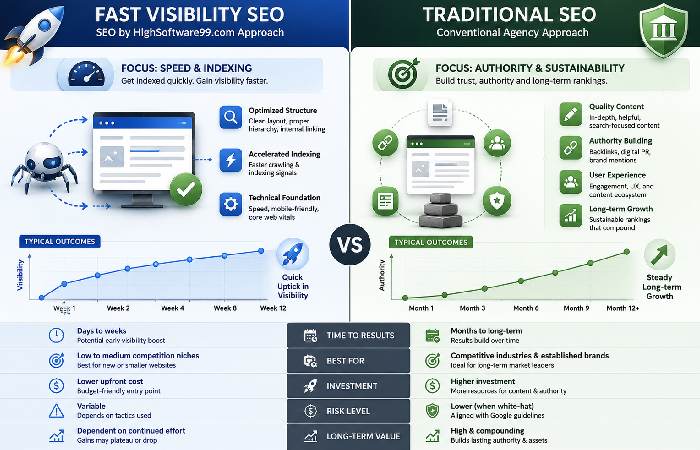
Here‘s the side-by-side comparison for two strategies that really matters when it comes to business decision. No strategy is better than the other, it all depends on what you‘re trying to achieve, when and how much risk you are willing to take.
| Dimension | SEO by HighSoftware99.com | Traditional SEO Agency | DIY SEO (Free Tools) |
|---|---|---|---|
| Speed to first results | Fast (days–weeks claimed) | Slow (3–6 months typical) | Slow (3–12 months) |
| Long-term sustainability | Uncertain — may require ongoing payments | High — builds owned assets | High — if done correctly |
| Google compliance risk | Variable — some tactics in gray area | Low (when using white-hat) | Low |
| Cost | Low–Medium (marketed as affordable) | Medium–High ($1K–$10K+/month) | Free (time investment only) |
| Scope of services | Narrow (structure, indexing, autocomplete) | Broad (content, links, technical, strategy) | Depends on your skill set |
| Authority building | Limited | Strong | Possible but slower |
| Client case studies | None publicly verifiable | Typically available | N/A |
| Best for | Small sites, low competition, quick start | Businesses needing durable growth | Budget-conscious site owners with time |
| Who controls risk | Largely the provider’s chosen tactics, which may not be fully disclosed. | Shared between you and the agency, with clearer contracts and processes. | Mostly you, based on how cautiously you follow public Google guidance. |
One thing worth noting — and this rarely gets said in the other reviews. The best test of any SEO service isn’t whether the provider’s own pages rank well. It’s whether their clients’ pages rank well. HighSoftware99’s own web properties clearly rank for the brand name. However, that‘s a totally different skill than getting a client‘s plumbing business ranked for “emergency plumber in Dallas.” So, ask for some client examples and check those out yourself before you buy.
How to Evaluate Any SEO Service — 7-Point Checklist
This checklist works for HighSoftware99 or any other provider. Use it before committing budget to any SEO service.
| # | Evaluation Criteria | What to Look For | Red Flags |
|---|---|---|---|
| 1 | Verifiable results | Named clients, ranking screenshots with dates, traffic data | “We’ve helped hundreds of clients” with zero specifics |
| 2 | Google compliance | Clear explanation of methods, no mention of manipulating search features | Promises to “control” autocomplete or guarantee #1 rankings |
| 3 | Transparency on tactics | Detailed breakdown of what they’ll do and why | Vague descriptions like “proprietary SEO methods” |
| 4 | Owned asset building | Content creation, earned backlinks, domain authority growth | Rankings that disappear if you stop paying |
| 5 | Realistic timelines | 3–6 months for meaningful results in most cases | “Results in hours” or “rank instantly” |
| 6 | Clear pricing structure | Defined scope, deliverables, and costs | Hidden fees, unclear retainer terms |
| 7 | Independent reviews | Third-party reviews, Trustpilot/Clutch profiles, Reddit discussions | Only testimonials on their own website |
Score any provider against these seven criteria. If three or more trigger red flags, proceed with extreme caution — or look elsewhere.
Three Questions to Ask on the First Call
- “Can you walk me through, step by step, what you’ll actually do in the first 90 days?”
- “Which of your tactics could Google potentially see as risky, and how do you mitigate that?”
- “Can you show me one client example where rankings stayed stable after they stopped paying you?”
The hard truth about SEO services? The ones that work best rarely promise the fastest results. And the ones promising speed rarely deliver lasting value. That tradeoff is real, and no marketing copy changes it.
Common Mistakes When Choosing an SEO Service
Most of the problems businesses face with SEO providers come from a few predictable missteps during the evaluation stage.
- Confusing “indexed” with “ranked.” Getting your page into Google’s index is step one. Ranking it for competitive terms is an entirely different challenge that requires content quality, authority, and time. Any service that conflates these is being misleading — whether intentionally or not.
- Not asking “what happens when I stop paying?” This is probably the single most revealing question you can ask any SEO provider. If the answer is “your rankings drop immediately,” you’re paying for rented visibility, not building business assets. Sustainable SEO creates value that persists even if you change providers.
- Trusting marketing claims from the provider’s own website. Of course they’ll say they’ve helped hundreds of clients. Look for independent verification — Clutch profiles, Google Business reviews, named case studies you can check yourself. If none exist, that’s a data point too.
- Ignoring Google’s actual published guidelines. Google publishes extensive documentation on spam policies, quality guidelines, and how SEO should work. Read it. It’s free. And it gives you a reliable framework for evaluating whether any service’s tactics are likely to help or hurt your site long-term.
- Assuming “affordable” means “low risk.” Budget-friendly SEO services can deliver great value. They can also cut corners in ways that create Google penalty risk. Price alone doesn’t tell you which one you’re getting.
Who Should Consider SEO by HighSoftware99.com?
Not every SEO service fits every situation. Here’s a straightforward breakdown of where this approach makes sense — and where it doesn’t.
Consider it if you’re:
- A solo website owner or blogger who’s never done structured SEO and needs a starting framework
- Running a small, niche site in a low-competition category where basic optimization can make a real difference
- Looking for an affordable entry point to understand how SEO works before investing in a full-service agency
- Willing to combine it with longer-term SEO efforts rather than treating it as your entire strategy
If You Decide to Try It, Do This Safely:
If you choose to run a small test:
- Begin with a restricted budget and a well-defined trial period rather than a protracted commitment.
- Track changes in Search Console (impressions, queries, and average position) from pre to post engagement.
- Trying to allow a single provider to control your entire domain strategy is a mistake. Don‘t give up your ownership of content, analytics and top account logins.
Look elsewhere if you:
- Have to compete for the most competitive (high traffic, high authority) keyword niches (e-commerce, finance, health, legal)
-
No need for a full digital marketing strategy, content creation & development, link building, paid media, analytics?
- Require verifiable case studies and transparent reporting before committing budget
- Can’t afford the risk of Google penalties from aggressive or non-compliant tactics
That second list isn’t a criticism specific to HighSoftware99. It applies to most narrowly-focused, speed-oriented SEO services. The service model has inherent limitations that no amount of good execution can overcome for certain use cases.
Final Verdict
So where does that leave you?
30‑Second Decision Flow
- You run a small, low‑competition site, have never done structured SEO, and want a guided starting point → This kind of service might be a reasonable short‑term test.
- You rely on search for serious revenue in a competitive niche → Prioritize providers that show named case studies, transparent tactics, and a clear focus on long‑term authority.
- You’re mainly curious about whether “instant appear” SEO is real → Treat this review as your answer and invest your time in fundamentals instead.
These are not rigid rules, but they should give you a quick sense of whether a speed‑focused, structure‑first service is aligned with your actual risk tolerance and growth goals.
Over SEO by HighSoftware99.com. Some of its elements such as logical hierarchy, semantic enhancement, and technical cleanup are actually sound SEO techniques that could help small sites. It seems aimed at beginners and relatively cheap site owners.
The speed claims, unverifiable performance metrics, autopilot-related strategies, and dependence danger temptasons make real concerns, which any prospective customer must bear in mind. The lack of publicly verifiable case studies is a significant drawback for a service with this extent of presence.
Our practical advice the 7 point checklist above is a great starting point if you are considering, and if you want to, you can utilize it to evaluate the service directly. Questions about Google compliance and what will happen if you stop paying, and whether you can get your hands on some proven client results are important to ask. And whether it is HighSoftware99, or what ever else, any SEO service should be an addition to a long-term focus on quality of content and subject domain authority never a substitute to it.
Best advice for most small businesses? Use free tools (Google Search Console, PageSpeed Insights), learn how structuring content and technical SEO works and then determine if you need professional services and what kind.
As you compare providers, keep Google’s own public documentation open in another tab — especially the SEO Starter Guide and Search Essentials. Use them as a neutral benchmark to sanity‑check any tactic that sounds too good to be true or doesn’t quite line up with how search is supposed to work.
Since algorithms and individual SEO providers are constantly evolving, it‘s also advisable to check the date of publication of this review and scan recent logs or discussions to the final judgment.
Frequently Asked Questions
Q: What is SEO by HighSoftware99.com?
A: It’s a branded SEO service focused on three things: organizing your site’s content into structured formats that search engines can parse efficiently, applying semantic SEO principles so your pages cover topics thoroughly, and accelerating how quickly Google indexes your new pages. Think of it as a “starter kit” approach to SEO — accessible pricing, narrower scope than a full agency, with an emphasis on speed over long-term authority building.
Q: Is SEO by HighSoftware99.com a scam?
A: Not straightforwardly. The core methodology — structured content, technical optimization, semantic coverage — aligns with legitimate SEO practices. The concern isn’t that the entire service is fraudulent. It’s that specific tactics (particularly anything involving autocomplete manipulation or artificial query generation) could violate Google’s spam policies, and the performance claims on official sites aren’t independently verifiable. That’s a transparency issue, not necessarily a scam — but it does mean you should verify before trusting.
Q: How did you evaluate SEO by HighSoftware99.com without being a customer?
A: This review is based on only public information available: the provider‘s own web sites and promotional claims, numerous independent articles and threads about the service, and how they compare to Google‘s documented SEO and spam policies. It does not factor in private data on clients, or hands-on campaign experience, so may be best viewed as a formal duediligence resource rather than expert testimony.
Q: How long does it take to see results?
A: What do you mean by “results.” Speeding up indexing of new pages? Within days though Google‘s free provided tools do that already. Improving rankings on highly competitive keywords? Certainly weeks, likely, months. If anyone promises you quickest place in hours, they‘re grossly underestimating how web search algorithms work.
Q: Can this replace traditional SEO entirely?
A: No. They establish structure and indexing, which while certainly important are only part of the wider spectrum of SEO essentials. In the long term, there’s also content quality, reputation-building backlinks, topical authority and good user experience which cost much more than a high-visibility, one-time service.
Q: What’s the deal with “SEO Instant Appear”?
A: Marketing language for faster indexing. The real mechanism is getting Google to crawl and store your pages more quickly after publication — which is useful but not the same as “ranking instantly.” Google Search Console’s URL Inspection tool and the IndexNow protocol do essentially the same thing, for free. The value-add from a paid service would need to go beyond what these free tools already offer — and that specific gap hasn’t been clearly demonstrated in public sources.
Q: What happens to my rankings if I stop using the service?
A: This is the question most reviews don’t answer directly, and the one that matters most. If your rankings depend on ongoing activity from the provider (like maintaining artificial search signals), they’ll likely drop when the service ends. If the service helped you build permanent improvements — better content structure, fixed technical issues, stronger semantic coverage — those benefits persist. Ask the provider explicitly which scenario applies before signing up.