

You entered “zlumeword.com” into Google expecting to find some sort of consensus. All you received was the homepage of the website itself, a couple of related sister domains, and a handful of Facebook posts offering guest post submission opportunities. Surprisingly not very hopeful.
Anyways… what is zlumeword.com? In a word a multi-topic WordPress blog that posts celebrity bios, general business articles, health tips, and some tech stuff. And it gets heaps of plgs and high promotion from SEO outlets as a guest-post destination with dofollow links. It is a legitimate site. It is live. But whether it is a good scam to trust be you as a reader or guest poster depends on a handful of things most people never verify.
This guide breaks down everything you’d want to know before interacting with zlumeword.com: what the site actually publishes, who appears to run it, how its trust signals stack up, what guest posting there gets you, and whether you should bother at all. We built this as an independent evaluation — not affiliated with zlumeword.com in any way.
This assessment uses publicly available information and signals from the live site and search engine results pages not privileged access, or security-technical auditing.
Table of Contents
Key Takeaways
- What is zlumeword.com?-> A multi-niche WordPress blog that specializes on the subject of Celebrity Biographies and general articles on business, health, technology and education.
-
Is it genuine? Yes it is, the page is still up and has been posting, but there‘s no sign of any trust signals, there‘s no “about us” page, no editorial policy, and contact is just using a free Gmail account.
- Should you guest post there? → Limited value for most SEO professionals — low domain authority and inconsistent content quality mean backlink impact is minimal
- Are there related sites? → Yes — zlumewords.com and thezlumeword.com appear connected, but that relationship isn’t disclosed anywhere
- Bottom line → Not a scam, but not a site that meets the editorial and trust standards most serious marketers look for
Should You Use Zlumeword.com? Quick Checklist
Use this quick filter before you spend time or money on zlumeword.com:
- You want: A cheap, low‑stakes placement mainly for experimentation, not serious link equity.
- You don’t need: Strong brand association, editorial oversight, or clear topical relevance.
- Your site is not: A YMYL property (health, finance, legal) where Google holds you to much higher E‑E‑A‑T standards.
- You accept: That one or two links from low‑authority, multi‑niche blogs are unlikely to move rankings in competitive SERPs.
What Is Zlumeword.com?
Zlumeword.com is a multi-topic blog built with WordPress. It publishes articles on diverse subjects such as celebrity profiles, business, education, finance, health and technology. Unlike your average blog, it is an aggregate of different unrelated niche topics.
A 40 word version (for those with limited time): zlumeword.com which is a multi niche WordPress Blog covering celebrities bio‘s, business learning‘s, health advice & technology news. According to SEO communities, zlumeword.com is used as a guest posting blog for dofollow backlinks to 3rd party authors.
The homepage doesn’t greet you with a mission statement or brand explanation. Instead, you land on a feed of recent posts — mostly biographical profiles of Indian entertainment figures. Navigation links across the top point to broad categories: Business, Education, Finance, Health. Standard WordPress blog setup.
Zlumeword.com at a Glance
| Element | What You’ll See on the Site |
|---|---|
| Platform | WordPress multi‑niche blog |
| Main content type | Celebrity biographies (Indian entertainment figures) |
| Other categories | Business, Education, Finance, Health, Technology |
| Homepage layout | Latest posts feed, category links in top navigation |
| Monetization signals | Guest‑post promotions, dofollow backlink offers in external communities |
Site Overview and Content Model
The publishing model is straightforward. Zlumeword.com operates like thousands of other multi-niche WordPress blogs: publish content across many categories, attract organic traffic through long-tail keywords (usually celebrity names and trending topics), and monetize through advertising, sponsored posts, or guest-post fees.
What is notable—and not in a good way–is how little the site offers to tell you about itself. There‘s not a simple About page that describes the site‘s mission. No listed editorial team. No policy about editing or vetting. Only contact info seen on every site property is a Gmail address and a WhatsApp number.
That’s a red flag for anyone evaluating this site professionally. Not a dealbreaker on its own. But notable.
The Three “Zlumeword” Domains — What’s the Connection?
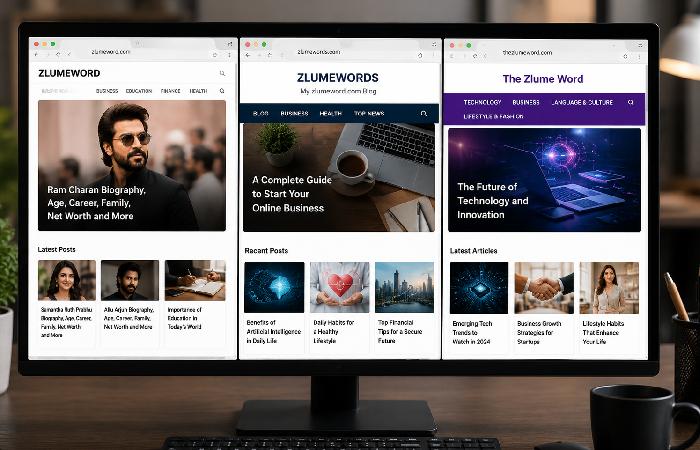
This is where things get confusing. Search for “zlumeword.com” and you’ll find three separate domains ranking:
- zlumeword.com — The main site. Celebrity biographies, multi-category blog posts.
- zlumewords.com — Calls itself “My zlumeword.com Blog.” Has its own categories (Blog, Business, Health, Top News) and includes a guide page explaining what zlumeword.com is.
- thezlumeword.com — Branded as “The Zlume Word.” Covers Technology, Business, Language & Culture, Lifestyle & Fashion. Run by an author named Haider Ali.
It‘s not quite obvious that these are the same operation, but they seem to be. The naming conventions of the sites are kind of suspicious though. No one of the sites makes without doubt that they are part of the same operation. This isn‘t common in real brand ecosystems, where you‘d expect at least a Cross-Linking, some shared About pages or even a comment in the footer.
For users, this creates confusion. For SEOs evaluating the domain, it raises questions about whether you’re dealing with a single entity operating multiple properties — a common pattern in private blog networks (PBNs) and scaled guest-posting operations.
What Does Zlumeword.com Actually Publish?
The honest answer? Mostly celebrity biographies. And a scattering of general articles across other categories.
Celebrity Biographies (Primary Content)
The most public content on the site and the pages that Google appears to care most about ranking is biographical profiles of Indian entertainment stars Madhubala, Riva Arora, Vidisha Srivastava, Anarkali Nazar, Zoya Hussain. All are structured in the same way:
- Title format: “[Name] — Biography, Age, Height, Husband/Boyfriend, Family, Net Worth, Career”
- Opening: One-sentence summary of who the person is
- Structure: Quick facts table, followed by biography sections, followed by career timeline
This is a well-known content pattern in the Indian entertainment SEO space. Sites publish these templated profiles at scale, targeting long-tail celebrity name searches. The approach works for traffic — but the content itself rarely adds original reporting, interviews, or sourced information beyond what’s already available on Wikipedia or IMDb.
Business, Education, Finance, Health, and Technology Articles
Beyond biographies, zlumeword.com publishes articles across broader categories. Recent titles include pieces on spatial computing, TinyML, exam alternatives, and brand partnerships.
The range is wide. Very wide. And that’s part of the issue — when a single blog covers everything from AI edge computing to Bollywood biographies to health advice, it’s hard to build genuine topical authority in any of them. Google’s own guidance on creating helpful content emphasizes that sites should demonstrate purpose and clear expertise, not just breadth.
Content Quality Assessment
Here’s where we stop being diplomatic. Based on a sample review of articles across multiple zlumeword.com categories, the quality appears inconsistent at best. Some observations:
- Biographical articles have a very defined template. It‘s bland, functional writing. It isn‘t sourced. There is no evidence to substantiate the claims made about net worth, height and some personal information.
-
Business and tech articles feel like google search summaries, afterword and covered more extensively for any given topic on a wide range of websites. No original data. No expert quotes. No case-specific examples. Recent titles like ‘Why Spatial Computing Is the Next Interface Shift’ and ‘How TinyML Brings AI to Low-Power Devices’ read like AI-generated overviews.
- The zlumewords.com “guide” page describing what zlumeword.com is opens with “In today’s rapidly evolving digital landscape” — a phrase so overused it’s practically a watermark for machine-generated content.
Does that make zlumeword.com worse than every other multi-niche blog? No. Plenty of sites publish at this quality level. But it doesn’t make a compelling case for the site as a trustworthy information source, either.
How to Cross‑Check Information from Zlumeword.com
If you do use zlumeword.com as a starting point, verify key facts by:
- Cross-referencing biographical information (dates, positions, filmography) against at least one reliable source such as recognized newspapers, official profiles, etc.
-
Verifying health or finance claims with authoritative sources, such as government health portals, major hospitals or established financial regulators for YMYL topics.
-
Is seeking consistency across multiple independent sources before trusting a single data point.
Is Zlumeword.com Legitimate? A Trust Signal Breakdown
“Legitimate” is a spectrum, not a binary. Zlumeword.com isn’t a phishing site. It isn’t distributing malware. It publishes real content on real web pages. In that narrow sense — yes, it’s legitimate.
But legitimacy for a content platform also means editorial transparency, consistent quality standards, and verifiable accountability. And on those criteria, the site falls short.
Legit to Load vs. Legit to Trust
It’s useful to separate two questions:
- “Is this safe to load in a browser?” (malware, phishing, obvious scams)
- “Is this a source I should trust for decisions about money, health, or my brand?”
Zlumeword.com currently clears the first bar but only weakly clears the second, especially for sensitive or YMYL topics.
What’s Present (and What’s Missing)
Let’s look at what you can actually verify:
Present:
- Active website with regular content updates (posts dated through early 2026)
- Clear category structure and functional navigation
- SSL certificate (HTTPS)
- Content indexed and ranking in Google
Missing:
- No About page or team bios
- No editorial policy or content standards documentation
- No author credentials or expertise indicators
- Contact via Gmail address and WhatsApp — no business email or physical address
- No privacy policy or terms of service readily visible
- No third-party reviews or mentions from established publications
Trust Signal Checklist
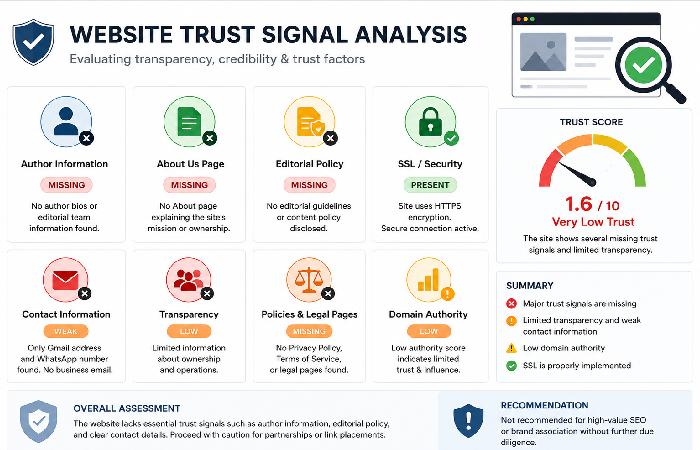
Use this checklist for zlumeword.com — or any website you’re thinking of trusting with your money, health, or brand reputation. You can literally copy‑paste it into your own audit template.
| Trust Signal | What to Look For | Zlumeword.com | Rating |
|---|---|---|---|
| About Page | Clear explanation of who runs the site and why | Not found | ❌ Missing |
| Editorial Policy | Content standards, fact-checking process | Not found | ❌ Missing |
| Author Bylines | Named authors with credentials or bios | Minimal (one author name on thezlumeword.com) | ⚠️ Weak |
| Contact Information | Business email, physical address, multiple channels | Gmail + WhatsApp only | ⚠️ Weak |
| Privacy Policy | GDPR/CCPA compliant privacy documentation | Not readily visible | ❌ Missing |
| SSL Certificate | HTTPS encryption | Present | ✅ Present |
| Content Freshness | Regular updates, recent publication dates | Active through 2026 | ✅ Present |
| External Citations | Referenced by independent, authoritative sources | None found | ❌ Missing |
| Domain Age | Established history | Relatively new | ⚠️ Neutral |
| Social Proof | Reviews, testimonials, community engagement | Facebook guest-post promos only | ⚠️ Weak |
For comparison, a strong content publication would typically score 8–10 on this same checklist. A decent mid-tier blog would score 5–7. Zlumeword.com sits well below average on standard trust indicators.
How to Run This Trust Check on Any Site
To apply the same lens to other sites:
- Open the domain in one tab and a search for
site:domain.com "about"in another to quickly locate About and policy pages. - Check for visible author names on recent articles and Google those names to see if they exist elsewhere in the niche.
- Use any reputable SEO tool to glance at basic metrics (referring domains, DR/DA) and look for a natural mix of links from relevant sites rather than only from link lists or guest‑post groups.
Guest Posting on Zlumeword.com — What to Expect

Ever scrolled through Facebook SEO groups and seen posts advertising “high traffic websites available for guest posting — 100% dofollow backlinks — permanent posts”? Zlumeword.com is one of the domains that shows up in those kinds of promotions. So let’s talk about what guest posting there actually gets you.
How the Guest Posting Model Works
Based on the Facebook promotions and the “Write for Us” pages across the zlumeword domain family, the model follows standard paid guest-posting practices:
- You (or your agency) submit an article — typically with one or two backlinks embedded
- The site publishes the post under its domain
- You get a dofollow backlink pointing to your target URL
- Payment is usually required, though specific pricing isn’t publicly listed
This is a common setup across hundreds of similar multi-niche blogs. The value proposition is simple: pay for a published article on an established domain, get a backlink, and (theoretically) pass link equity to your site.
Backlink Value — Realistic Expectations
Here’s the part most guest-post promoters won’t tell you. The SEO value of a backlink depends on several factors — and zlumeword.com scores low on most of them.
Factors that determine backlink quality:
- Domain Authority / Domain Rating: Third‑party SEO tools currently estimate zlumeword.com’s DR in a low range (typically under 30), which suggests its backlinks are likely to pass limited ranking power compared with stronger domainsf. Moz’s guide to Domain Authority explains how this metric works and why it matters.
- Topical relevance: A backlink from a celebrity biography page to your SaaS product has virtually zero topical connection. Google’s algorithms weigh relevance heavily.
-
Editorial context: Is the link there because it actually helps the user, or has someone paid for it? Google‘s spam policies regarding link spam include references to paid links resulting in passing PageRank with full disclosure.
-
Signals of quality on the site: Low E-E-A-T, thin content and patterns of templated publishing diminish how much trust Google places in outward links on that domain.
So what does a guest post on zlumeword.com actually get you? Honestly — probably not much. A low-DA link from a multi-niche site with weak editorial standards and no topical authority in your niche is unlikely to move your rankings in any meaningful way.
Think of it this way: if your competitors are earning links from focused, high‑authority industry sites, a handful of links from low‑authority, off‑topic blogs are unlikely to close that gap — no matter how many times the word “high traffic” appears in a Facebook pitch.
Could it hurt you? Possibly, if you’re building a large number of similar links. Google’s link spam detection has gotten aggressive — particularly around scaled guest-post link schemes. One link from zlumeword.com probably won’t trigger a penalty. But a pattern of paid placements across dozens of similar sites absolutely could.
If You Still Want to Test It, Do This Safely
- Use branded or very soft‑anchor text rather than aggressive money keywords.
- Limit placements on the same multiniche sites so your link profile doesn‘t look like a pure guestpost footprint.
-
Before retesting, see if the page receives any impressions or clicks in Search Console.
Comparison With Similar Multi-Niche Guest Post Sites
How does zlumeword.com stack up against the broader guest-posting landscape? Here’s a realistic comparison framework:
| Factor | Zlumeword.com | Mid-Tier Guest Post Sites (DR 40–60) | High-Quality Publications (DR 70+) |
|---|---|---|---|
| Domain Rating | Under 30 (estimated) | 40–60 | 70+ |
| Content Quality | Template-driven, inconsistent | Moderate, some editorial review | Strong editorial standards |
| Topical Authority | None (multi-niche) | Usually niche-focused | Deep authority in specific areas |
| Author Attribution | Minimal | Basic bylines | Full author profiles + credentials |
| Link Value | Very low | Moderate | High |
| Risk Level | Moderate (link spam patterns) | Low to moderate | Low |
| Typical Cost | Low (estimated <$50) | $100–$500 | $500–$2,000+ |
The tradeoff is clear. You get what you pay for. Cheap placements on low-authority multi-niche sites deliver cheap results — and carry higher risk than investing in fewer, better placements on authoritative, niche-relevant publications.
Common Mistakes When Evaluating Sites Like Zlumeword.com
Most people make the same errors when evaluating unfamiliar content platforms. These five come up again and again.
- Assuming “it ranks in Google” means it’s trustworthy. Plenty of low-quality sites rank — especially for brand-name queries where they have no competition. Ranking is not an endorsement.
- Using domain age as a quality signal. A three-year-old domain isn‘t necessarily more trustworthy than a one-month-old domain. It‘s what has been published on the domain, the author or publisher behind it, and if any authorities link to it that counts.
- Confusing “active” with “authoritative.” Zlumeword.com publishes regularly. That’s good for freshness signals. But publishing volume doesn’t equal editorial rigor. A site that posts 50 articles a month with no fact-checking isn’t more trustworthy than one that posts 5 well-sourced pieces.
- Ignoring the business model. When a site’s primary revenue appears to come from selling guest posts and backlinks rather than serving readers — that tells you something about whose interests the content prioritizes. Follow the money.
- Skipping the About and Contact page check. This takes 30 seconds. If a content site can’t tell you who runs it, why they created it, and how to reach a real person — that’s information the site chose not to provide. Ask yourself why.
Who Should Use Zlumeword.com (and Who Shouldn’t)
Not every site is for every purpose. Here’s a straight breakdown.
Might be reasonable for:
- Beginners learning how guest-post outreach works and wanting low-stakes practice
- Content marketers running tests across many low-cost placements as part of a broader strategy (with eyes open about the limited SEO value)
- Casual readers looking up basic celebrity information who don’t need deeply sourced content
Probably not worth it for:
- SEO professionals building high-quality backlink profiles — the DA is too low and the risk-to-reward ratio doesn’t justify it
- Brands that care about where their name appears — association with thin, templated content reflects poorly
- Anyone attempting to use a single guest-post, placement to absolutely increase rankings (one link from a weak-authority multi-niche page won‘t cut it)
-
Users looking for confirmed health, financial, or legal information the site has no obvious editorial control of such content
Note for YMYL Site Owners: If your site falls under “Your Money or Your Life” categories, Google expects a high bar of E‑E‑A‑T from any content associated with you. Links from low‑transparency, thin‑content blogs are unlikely to help and may dilute the overall trust profile you’re trying to build.
That last point matters more than people realize. Zlumeword.com publishes health and finance content with no visible author credentials, no source citations, and no editorial review process. For topics that fall under Google’s “Your Money or Your Life” (YMYL) standards, that kind of unsourced, low‑transparency coverage falls short of the higher bar Google expects for user safety and reliability.
Final Verdict
Zlumeword.com functions as a multi-niche WordPress blog built primarily around high-volume, template-driven celebrity content, with broader category coverage that mostly reads as surface-level. The site is functional, active, and not engaged in anything overtly malicious.
However, “not malicious” is a pretty low standard. The visible trust indicators if lacking (no About page, no editorial policy, no credentialed authors, just a Gmail.com email address) is a significant step below any standard experienced marketers, SEOs or critical readers would set for a reputable content source.
If you’re evaluating zlumeword.com for guest posting, the math is simple. Low domain authority plus weak content quality plus no topical specialization equals minimal backlink value with non-trivial risk. Your budget is almost certainly better spent on fewer, higher-quality placements elsewhere.
And if you’re just a reader who landed on zlumeword.com through a search result? The content will give you basic information. But verify anything important against a better-sourced publication before acting on it. That’s good practice for any unfamiliar site — not just this one.
Frequently Asked Questions
Is zlumeword.com a legitimate website?
Hmm. Depends what you mean by legitimate. The website itself is legitimate it‘s a real site with an active domain, published content and its pages are indexed by Google. Can‘t get much more legitimate than that. But it is missing the sorts of transparency signals any established publication would have no About page, no editorial policy, no named editors, just a Gmail address to contact. It‘s neither scam nor phishing site, merely an low authority, multi-niche blog.
Who owns zlumeword.com?
This is not publicly available on the actual site. The second of the associated sites thezlumeword.com, simply lists an author Haider Ali and an email address (Haider. Ali@thezlumeword.com). Thezlumeword.com variation displays contact details via a UK registered Gmail account and WhatsApp contact number. No corporate organisation, registered business or recognizable owner is demonstrated from any of these three URLs.
Can I guest post on zlumeword.com?
Yes — guest posting appears to be a core part of the site’s business model. Multiple Facebook SEO group posts promote zlumeword.com (and its variants) as accepting guest posts with dofollow backlinks. Specific pricing and submission processes aren’t publicly listed on the main site, though thezlumeword.com has a “Write for Us” page.
What is the domain authority of zlumeword.com?
Low. According to the estimates of various available SEO tools, the domain authority is below 30. Metrics such as Domain Authority or Domain Rating are an estimate made by a third-party to show the strength of back links, so cannot be considered an accurate measure of where a site ranks on Google. However they can be useful indicators when comparing sites at a high level, for context many SEOs tend to notice more consistent effects from links on sites that have a DR of between 40–50+, but even then topic-relevancy and general site quality usually have more influence on rank than the raw number.
Is zlumeword.com safe to visit?
This site is on HTTPS (has SSL cert), no indication of malware/phishing/malicious redirect at the time of writing (early 2026). Same rules as for general safety (don‘t fill sensitive fields in, don‘t download from unknown sites, keep your browser up-to-date).
What’s the difference between zlumeword.com, zlumewords.com, and thezlumeword.com?
All three seem to have a connection like it‘s owned and managed by same brain or one person, but it‘s not quite mentioned anywhere. Zlumeword.com is a blog which concentrates on celebrity biographies and multi-category articles. Zlumewords.com is a guide for the main blog. TheZlumeWord.com is another blog, general content site with more wide topics written by Author Haider Ali.
Before acting on anything here, especially for YMYL decisions or significant SEO spend, re‑check the site and its policies directly — and compare them against Google’s latest guidance on helpful, people‑first content.